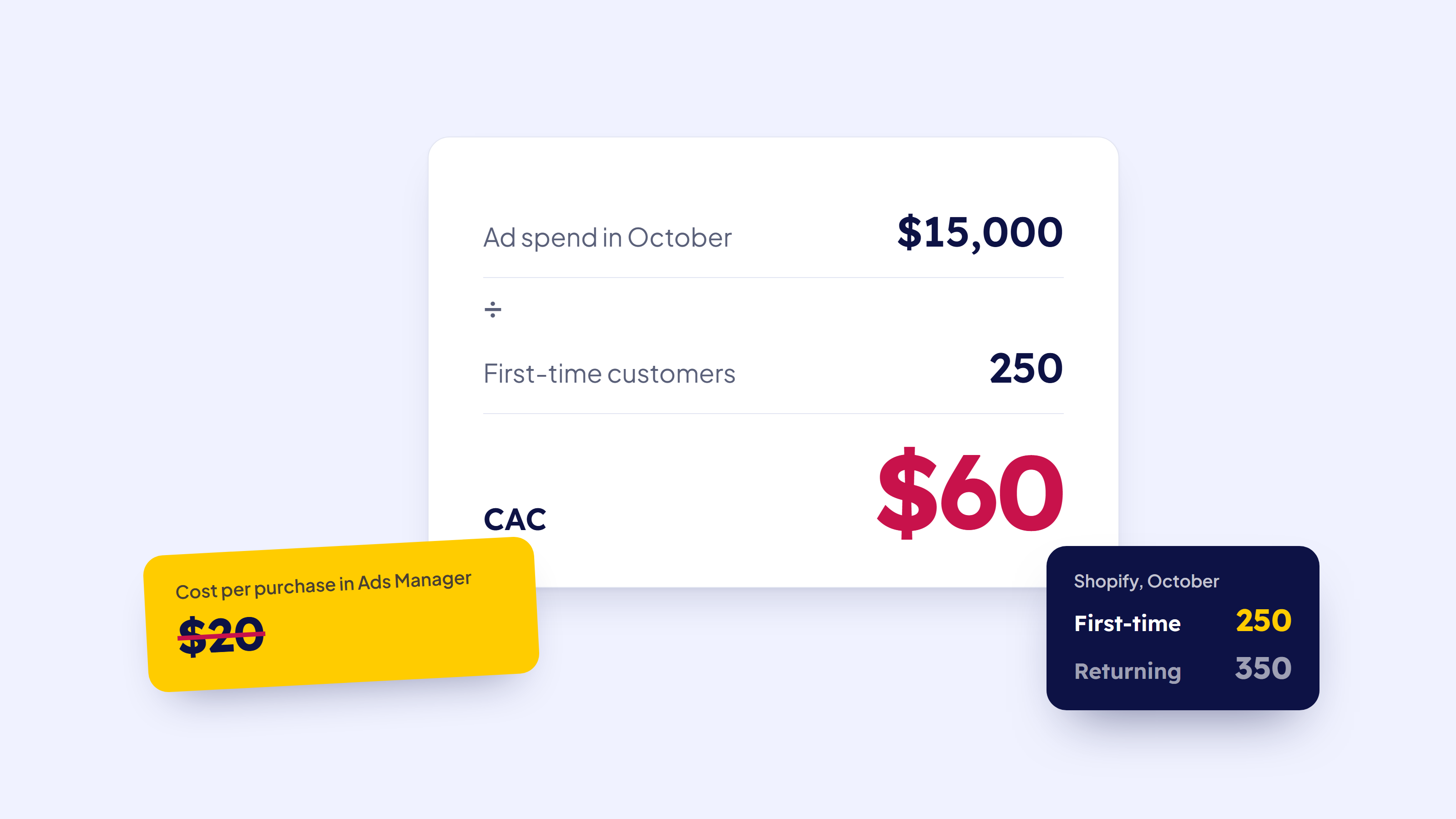


Ads Manager says you paid $20 per purchase last month. Shopify says more than half of those buyers had ordered from you before. So what did a new customer cost you?
Short answer: Customer acquisition cost (CAC) is your marketing spend divided by the number of new customers you won in the same period. For a Shopify store, count only first-time customers, not orders. If you spent $15,000 on ads in a month and 250 people bought from you for the first time, your CAC is $60, even if your ad platforms show a cost per purchase of $20.
The difference matters because CAC decides how much you can afford to spend on growth. A CAC that is three times too low makes every campaign look profitable. This guide covers the CAC formula, a worked Shopify example, a free CAC calculator, the difference between blended and new-customer CAC, and how to work out your CAC payback period.
The customer acquisition cost formula
CAC = acquisition spend ÷ new customers acquired
Both numbers come from the same period, usually a month. Where stores go wrong is in what they put into the formula.
For spend, the minimum is your ad spend across Meta, Google, TikTok and Pinterest. A fully loaded CAC also includes the other costs of winning customers: agency fees, creative production, influencer fees and the tools you use for acquisition. Both versions are useful. Pick one, write down what goes in it, and keep it the same every month so you can compare.
New customers are people who placed their first order with you in that period. That excludes repeat orders, purchases your ad platforms report, and customers who had bought from you before. Someone who ordered in March and again in October is not a new customer in October.
CAC sits next to ROAS and MER as one of the three numbers most stores run on. ROAS judges a campaign, MER judges your marketing as a whole, and CAC tells you what each new customer costs. Our glossary has a short comparison of ROAS, CAC and MER.
How to calculate CAC step by step
To calculate customer acquisition cost for one month, you need two numbers you already have.
- Add up your ad spend. Take the spend for the month from Meta, Google, TikTok and Pinterest. Add agency and creative costs if you want the fully loaded version.
- Find your first-time customers. In Shopify, go to Analytics, then Reports, and open the New vs returning customers report. It shows how many first-time and returning customers ordered in the period.
- Divide spend by first-time customers.
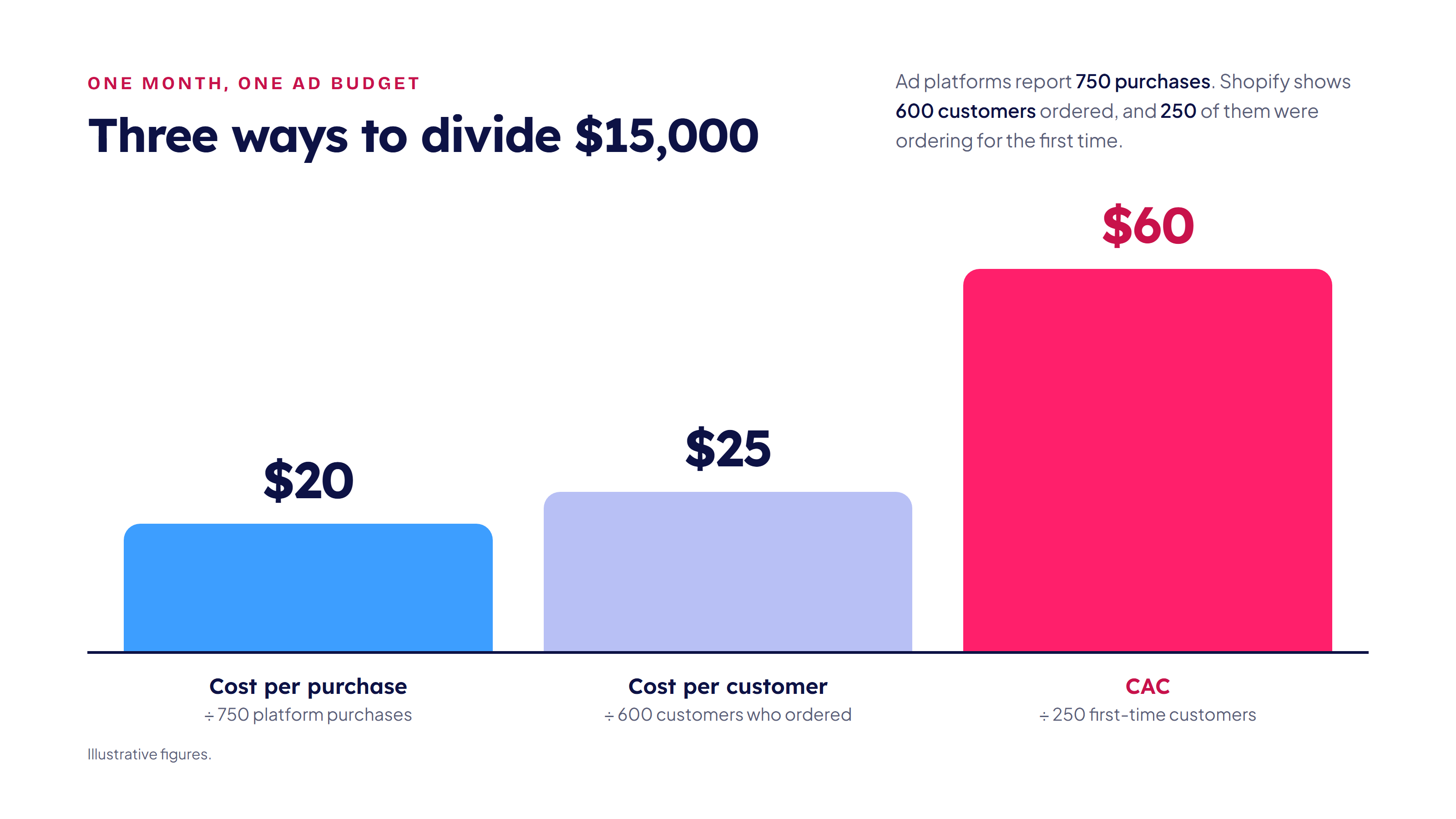
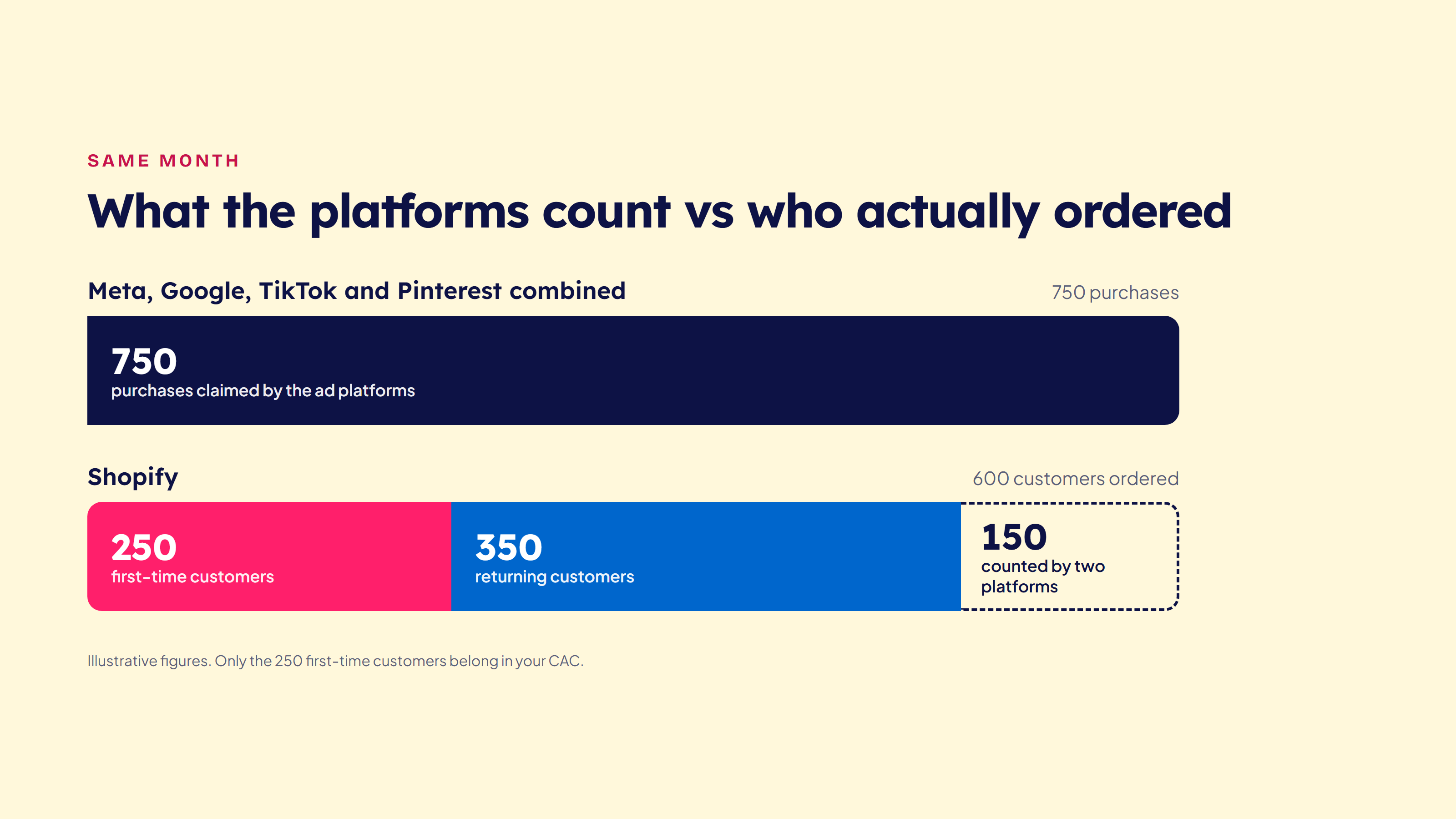
Worked example: In October you spent $15,000 on ads. Your ad platforms report 750 purchases between them. Shopify shows 600 customers placed an order that month, and 250 of them were ordering for the first time.
CAC = $15,000 ÷ 250 = $60
Now look at the other two numbers you could have used:
- Spend ÷ platform purchases: $15,000 ÷ 750 = $20. That is the cost per purchase the platforms show you.
- Spend ÷ all customers who ordered: $15,000 ÷ 600 = $25. Closer, but it still includes 350 people who were already your customers.
- Spend ÷ first-time customers: $15,000 ÷ 250 = $60, your CAC.
Same month, same spend, and the answer ranges from $20 to $60 depending on what you divide by.
If you add $3,000 in agency fees and creative costs, your fully loaded CAC is $18,000 ÷ 250 = $72.
Free CAC calculator
Fill in your ad spend and the number of first-time customers to get your CAC. Add your average first order and gross margin to see whether that first order pays for the customer, and add your total customers to see how far off the "per customer" number is.
CAC calculator
Spend divided by first-time customers, for the same month.
Does the first order pay for it?
Compare CAC with the gross profit on a new customer's first order.
Fill in your ad spend, first-time customers, first order value and margin to see whether a new customer pays for itself on the first order.
CAC = spend ÷ first-time customers. Ad platforms count returning customers as purchases too, so use Shopify's first-time customers here. See how TrackBee tells your ad platforms who is new.
Blended CAC vs new-customer CAC
You will see a few versions of CAC. They answer different questions.
Blended CAC = total marketing spend ÷ all new customers
Blended CAC uses every new customer, including the ones who found you through organic search, email or word of mouth. It is easy to calculate and doesn't depend on attribution, which makes it the most reliable store-level number. It is the CAC version of MER, the marketing efficiency ratio. If you track acquisition MER (new-customer revenue divided by spend), blended CAC is its counterpart in customers instead of revenue.
Paid CAC = paid ad spend ÷ new customers from paid channels
Paid CAC only counts the new customers your ads brought in. It is closer to the question "what do my ads cost per new customer", but it depends on attribution, so it is only as good as the data your platforms and Shopify share.
Channel CAC = spend on one platform ÷ new customers that platform drove
Use it to compare Meta with Google or TikTok, with the same attribution caveat.
What all three have in common is the denominator: new customers. The most common CAC mistake is dividing by all orders or all customers. Returning customers then make your CAC look lower than it is, and the more loyal your customers are, the bigger the error.
Why cost per purchase in Ads Manager is not your CAC
The cost per purchase (or CPA) your ad platforms show is a different metric. It divides spend by every purchase the platform attributes to its ads, and three things push it away from your real CAC.
It counts returning customers
Platforms don't know who bought from you before unless you tell them. A repeat customer who clicks a retargeting ad and buys again counts the same as a brand new buyer. Some of those customers would have come back anyway, through an email or by typing in your URL.
The algorithm prefers existing customers
Advantage+ and Performance Max look for the cheapest conversions they can find. People who already know and trust your brand convert more easily, so campaigns drift toward them. We covered how that eats into budget in how to stop wasting Meta ad budget on returning customers.
Platforms claim the same order
A shopper sees a TikTok video, clicks a Meta ad and buys after a Google search. All three can claim the order. That's why the platforms in the example report 750 purchases while only 600 customers placed an order.
Pixels miss purchases too
One issue works in the opposite direction. Browser pixels miss around 30-60% of conversions because of ad blockers, iOS privacy rules and declined cookie banners, which means the platform's number is inflated in some places and incomplete in others. If your numbers never seem to line up, our guide on why your Shopify sales don't match your ad platforms goes through the causes one by one.
So use ad platform CPA to compare campaigns within one platform, and use Shopify's first-time customers to calculate CAC.
How to calculate your CAC payback period
CAC on its own doesn't tell you whether a customer is worth $60. For that you need to know how long it takes to earn the $60 back.
CAC payback period = the number of months until a new customer's gross profit covers your CAC
Use gross profit, not revenue: order value minus product cost, shipping and payment fees. Then follow a group of new customers over time.
Worked example: Your average first order is $80 and your gross margin is 50%, so the first order earns $40 in gross profit. That leaves $20 of your $60 CAC unpaid. Some of those 250 customers order again in the following months. Averaged over the whole group, including the ones who never come back, gross profit per customer reaches $52 after three months and $63 after six.
Your CAC payback period is six months.
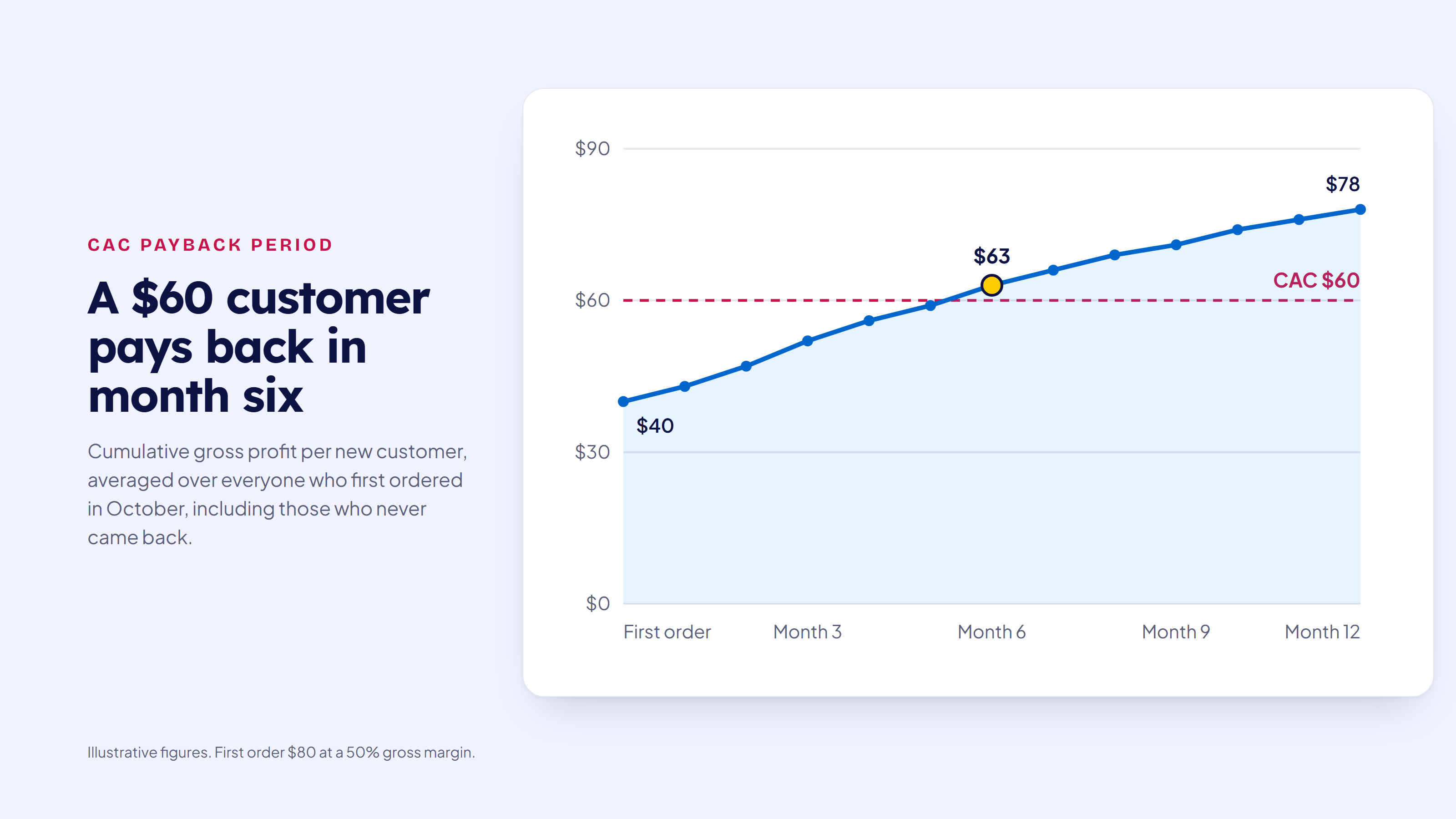
You can also turn the question around and calculate the most you can pay for a new customer. If you want to earn back CAC within three months, your maximum CAC in this example is $52. If you need the first order to pay for itself, it's $40.
To find these numbers for your own store, look at customers who first ordered in one month and add up their gross profit in each month that follows. Shopify's customer cohort analysis shows how many of them come back.
LTV to CAC ratio
The LTV to CAC ratio compares what a customer is worth over their lifetime with what it cost to acquire them.
LTV to CAC ratio = customer lifetime value ÷ CAC
Use gross profit for LTV here too, and pick a fixed window like 12 months. In the example, 12-month gross profit per customer is $78, so the ratio is $78 ÷ $60 = 1.3.
You will often read that a good LTV to CAC ratio is 3:1. That rule of thumb comes from subscription software, where customers pay every month for years. For most Shopify stores, the payback period is the more practical check, because it tells you how long your cash is tied up in each new customer.
Lifetime value comes from repeat purchases, and a lot of what drives the second order happens after checkout: delivery, returns, and how support handles questions. HumanTouch CX wrote about that for us in customer retention starts before the second purchase.
What is a good CAC for a Shopify store?
There's no single good CAC. A $60 CAC is expensive for a store selling $25 phone cases once, and cheap for a store selling $150 supplements every month. What makes a CAC good is how it compares with your own numbers:
- Your first-order gross profit. If CAC is below it, every new customer is profitable from the first order.
- How long you can wait. If repeat orders earn CAC back within that window, you can keep spending.
- The trend. A CAC that climbs month after month while spend stays flat means your ads are finding fewer new buyers per dollar, even when ROAS looks fine.
How to lower your new-customer CAC
Most CAC problems trace back to two gaps in what your ad platforms see. They miss part of your purchases, and they can't tell a new customer from a returning one.
Tell your ad platforms who is new
If Meta, Google and TikTok only see "purchase", they optimize for any purchase. When each purchase is labelled as new or returning, they can bid for first-time buyers. Google Ads has a new customer acquisition goal for this, and Meta Sales campaigns have a customer lifecycle setting to focus on new customers. Both only work if the platform knows who your existing customers are. TrackBee tells your ad platforms which orders come from new customers. For every purchase, Meta, Google Ads, TikTok and Snapchat learn whether it came from a new or a returning customer.
Keep existing customers out of acquisition campaigns
Exclude past buyers from prospecting, and keep that list current. TrackBee syncs a Meta audience of all your customers and updates it every 5 to 15 minutes, so someone who bought this morning drops out of your prospecting campaigns the same day.
Close the tracking gap
If the platforms miss around 30-60% of your purchases, they optimize on a skewed sample of your buyers. Server-side tracking sends each Shopify purchase from your store's backend and enriches it with first-party data, so the platforms see more of your real customers. More on how this affects acquisition in how to optimize your conversions for new customers.
Judge campaigns on new customers
Compare CAC per channel, and look at new-customer ROAS next to platform ROAS. Our post on POAS and new vs returning customers in TikTok shows what that looks like for one platform.
Frequently asked questions
What is the CAC formula?
CAC = acquisition spend ÷ new customers acquired in the same period. $15,000 in ad spend and 250 first-time customers gives a CAC of $60.
How do you calculate customer acquisition cost for ecommerce?
Add up your ad spend for the month across all platforms, then divide it by the number of first-time customers in Shopify for the same month. Don't divide by orders or by all customers, because returning customers make CAC look lower than it is.
What is blended CAC?
Blended CAC is your total marketing spend divided by all new customers, from every channel including organic. It doesn't depend on attribution, so it is the most reliable store-level version of CAC.
What is a good CAC for a Shopify store?
It depends on your margin and how often customers come back. A CAC below your first-order gross profit is profitable from the first order. Above that, it is fine as long as repeat purchases earn it back within the payback period you can afford.
How do you calculate CAC payback period?
Follow the customers who first ordered in one month and add up their gross profit per customer, month by month. The month in which that total passes your CAC is your payback period.
What is a good LTV to CAC ratio?
The common rule of thumb is 3:1, using gross profit for LTV. It comes from subscription software. For ecommerce, check your CAC payback period as well, because it shows how long your cash is tied up in each new customer.
Why is my CAC higher than my cost per purchase in Meta?
Meta's cost per purchase counts every purchase it attributes to your ads, including repeat customers and orders other platforms also claim. CAC only counts first-time customers, so it is almost always higher.
Calculate CAC on first-time customers
Calculating CAC takes a minute once you divide by first-time customers. Getting your ad platforms to bid for those customers takes better data. TrackBee sends every Shopify purchase server-side to Meta, Google, TikTok, Pinterest, GA4 & Klaviyo and enriches it with first-party data. Meta, Google and TikTok also learn whether each purchase came from a new or a returning customer, so your acquisition campaigns can bid for first-time buyers.
Read next: How to calculate ROAS | Marketing efficiency ratio | Ecommerce metrics to track