

BFCM (Black Friday and Cyber Monday) runs from Friday 27 November to Monday 30 November this year. For most Shopify stores these are the busiest four days of the year, and Meta, Google and TikTok decide who sees your ads based on the purchases they receive. Browser pixels miss around 30-60% of conversions, so in your most expensive week the algorithms learn from half the picture. TrackBee fixes that from one Shopify app, and you can still set it up before the sale starts.
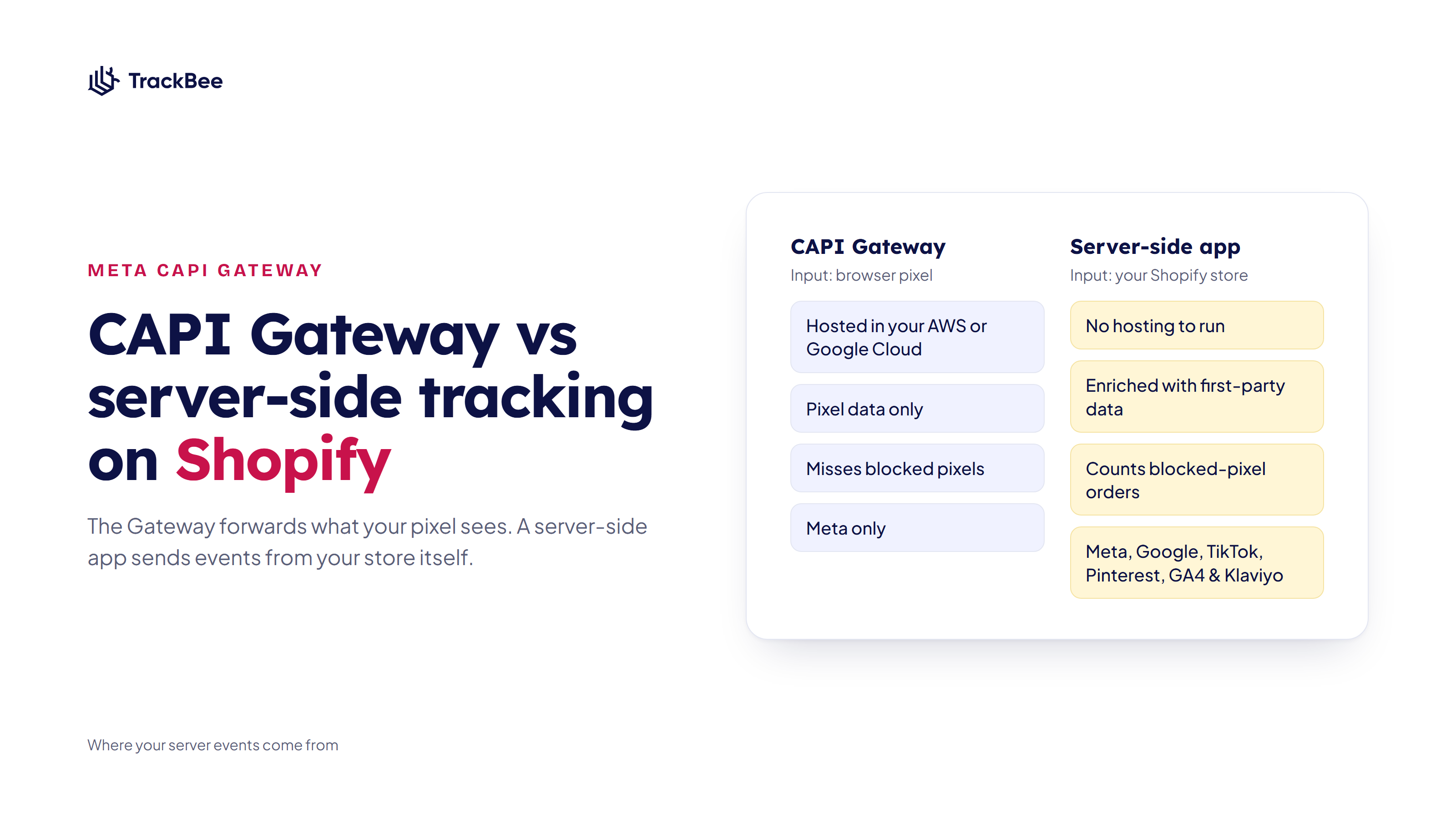
Short answer: Before Black Friday, every purchase should reach Meta, Google, TikTok, Pinterest, GA4 & Klaviyo, counted once, enriched with first-party data and labelled as a new or returning customer. You can check and patch that by hand on every platform. Or you install TrackBee, which sends every Shopify event server-side, enriches it with first-party data, deduplicates it against your pixel and adds the new vs returning signal. Setup takes under five minutes, so there is still time to switch before 27 November.
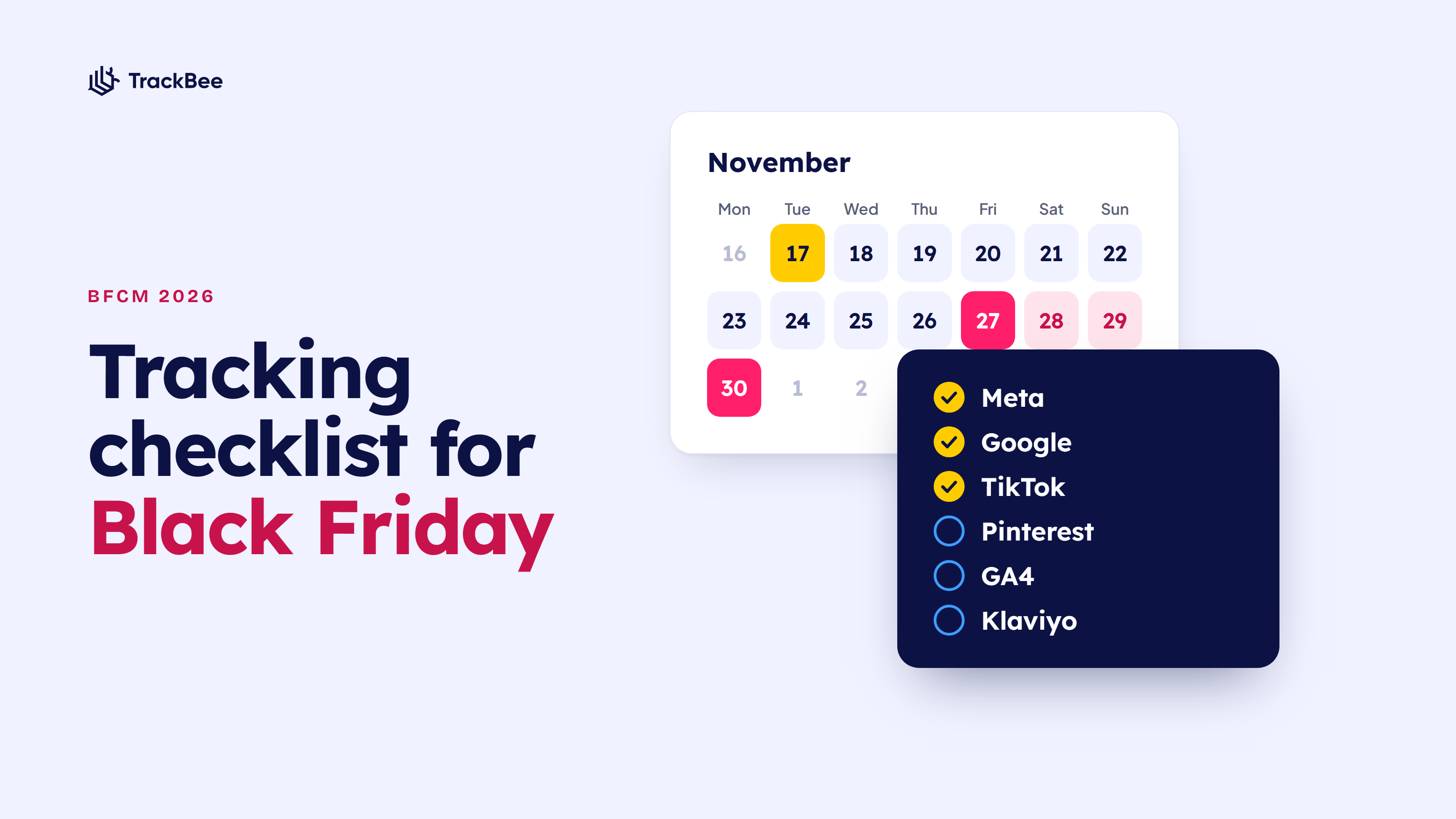
BFCM 2026 dates at a glance
| Date | Day | What to do |
|---|---|---|
| 17 to 24 Nov | Tue to Tue | Get your tracking right, or switch to TrackBee, and set your targets |
| 25 to 26 Nov | Wed to Thu | Place a last test order and compare platform numbers with Shopify |
| 27 Nov | Friday | Black Friday |
| 28 to 29 Nov | Sat to Sun | Small Business Saturday, weekend sales |
| 30 Nov | Monday | Cyber Monday |
| 1 to 7 Dec | Week after | Move new buyers into exclusions and retention flows |
| Mid-Dec | Final review, once refunds are in |
Before the sale: 17 to 24 November
This is the week to get your tracking right. Anything you set up now still gets a few normal days of data before the sale, so the platforms have time to learn from it.
Make sure every purchase reaches your ad platforms
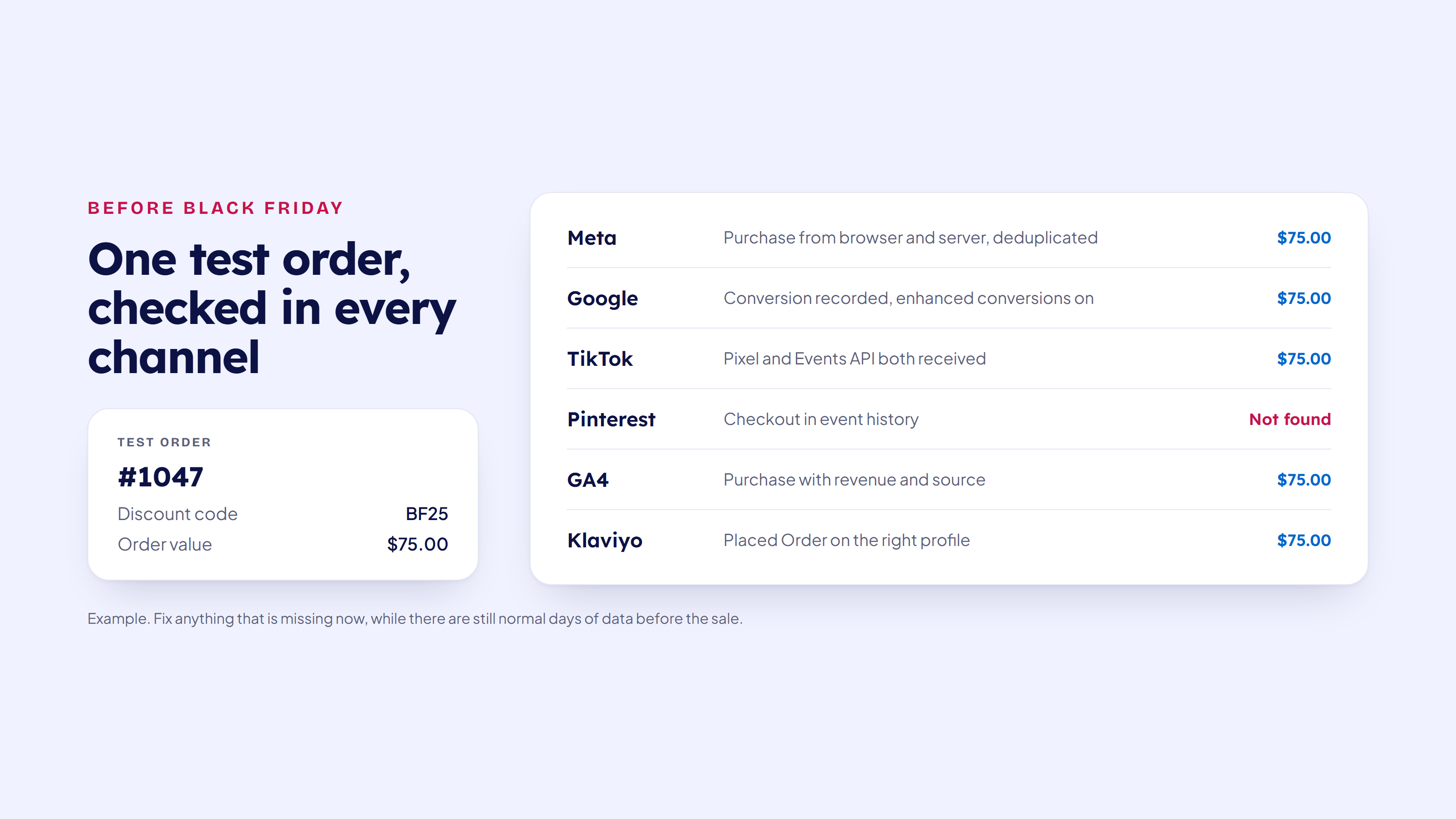
Place a cheap test order with a discount code and follow it through every platform you advertise on:
- Meta: the Purchase event arrives in Events Manager with the discounted value, from browser and server.
- Google Ads: the conversion shows up in the Conversions report, with enhanced conversions active. If you sell in the EU or UK, check that Consent Mode V2 is set up.
- TikTok: the order arrives through the pixel and the Events API.
- Pinterest: the checkout event shows in Pinterest's event history.
- GA4: the purchase lands with the right revenue and source.
- Klaviyo: the Placed Order event fires and the profile is updated.
A test order from your own browser will usually look fine. The orders that go missing come from shoppers with ad blockers, iOS privacy rules or a declined cookie banner, and that is where browser pixels lose around 30-60% of conversions. So also compare last week's platform conversions with Shopify orders for the same days. If Meta reports far fewer purchases than you had orders, that gap will follow you into Black Friday.
How TrackBee handles it: TrackBee runs next to your browser pixels and sends every key Shopify event (product views, add to cart, checkout steps and purchases) server-side to Meta, Google, TikTok, Pinterest, GA4 & Klaviyo. Purchases the pixel misses still reach the platforms. You don't remove anything you have running now.
Count every order once
When the pixel and a server connection both send the same purchase without a shared event ID, the platform counts it twice. It often happens next to Shopify's own Facebook & Instagram app, or after a second tracking app was added. Your ROAS looks great and doesn't match your orders. In Events Manager, open the Purchase event and check that browser and server events are deduplicated.
How TrackBee handles it: built-in deduplication matches every browser event with its server event, so each order is counted once in your ad platforms and in Klaviyo.
Help the platforms recognize your buyers
Meta and Google can only use a purchase if they can tie it to a person who saw an ad. Meta shows this as Event Match Quality, Google as enhanced conversion coverage. During BFCM you get many first-time visitors with little data attached, so a low score now costs more than usual.
How TrackBee handles it: every event is enriched with first-party data: hashed email and phone, click IDs, product and order details, device and session context. TrackBee also keeps a persistent shopper profile for every visitor, across sessions and devices, so someone who clicks on Thursday and buys on Monday is still recognized.
Tell your ad platforms who is new
BFCM pulls in a lot of existing customers through email and SMS. If your prospecting campaigns reach them too, you pay acquisition prices for people who would have bought anyway. Exclude existing customers from prospecting on Meta, Google and TikTok, and keep a separate campaign for them if you want to reach them with paid.
Platforms only know who is new if you tell them. Our post on optimizing for new customers explains how that signal works.
How TrackBee handles it: TrackBee sends a new vs returning signal with every purchase, so your platforms can optimize for first-time buyers. With Custom Audience Sync it keeps your audiences up to date from real shopper profiles, which you can use as suppression lists for prospecting or as the base for lookalikes.
Make sure Klaviyo sees the extra visitors
BFCM brings far more anonymous visitors than a normal week. Klaviyo can only start a browse or cart abandonment flow for a visitor it can identify, so most of that extra traffic never enters your flows. Check that your abandoned cart and browse abandonment flows are live, mention the BFCM offer, and have short enough delays for a four-day sale.
How TrackBee handles it: TrackBee sends enriched shopper profiles and events to Klaviyo, including visitors who were anonymous until they left an email. More of them enter your abandonment flows. Stores report 2-3x more abandonment flow revenue.
Set your targets at the discount you will run
A discount lowers your margin, which raises the ROAS you need to break even. Break-even ROAS is 1 divided by your margin after product costs, shipping and fees. A product with a 60% margin breaks even at a ROAS of 1.67. At 25% off, break-even rises to about 2.14. At 40% off it is 3.00. Our guide on how to calculate ROAS has the full formula.
Also set a target for MER (total revenue divided by total ad spend). No platform can claim credit in it, so it is the number to fall back on when platforms disagree.
Is there still time to switch before Black Friday?
Yes. TrackBee installs as a Shopify app and setup takes under five minutes, with no developer. It runs next to the pixels you already have, so there is nothing to rip out the week before your biggest sale.
Set it up by 24 November and Meta, Google and TikTok get a few days of complete, enriched data before Black Friday. You can try it free for 30 days, which covers the whole of BFCM and your review afterwards.
Last check: 25 and 26 November
Two days before the sale, check that everything works end to end.
- Place one more test order and check it in every platform, the same way as above.
- Compare the last few days of platform purchases with Shopify orders. That ratio is your baseline for the sale.
- Check your discount codes in Shopify: start and end times, minimum order values and which products they apply to.
- Check your landing pages on mobile, including load speed. Most BFCM traffic comes from phones.
- Agree on a daily routine: who checks the numbers each morning, and who decides on budget changes.
During the sale: 27 to 30 November
Ad platforms update every few hours and budget decisions get made just as fast. A 15-minute check each morning tells you whether you can trust what you see.
| What to check | Where | What it tells you |
|---|---|---|
| Platform purchases vs Shopify orders | Each ad platform and Shopify | Whether tracking still matches your baseline |
| MER | Shopify revenue and total spend | Whether the sale as a whole is profitable |
| ROAS per campaign vs break-even at the discount | Each ad platform | Which campaigns earn their budget |
| New vs returning buyers | Shopify, or your platforms with the TrackBee signal | Whether prospecting really finds new customers |
| Klaviyo flow revenue | Klaviyo | Whether abandonment flows catch the extra traffic |
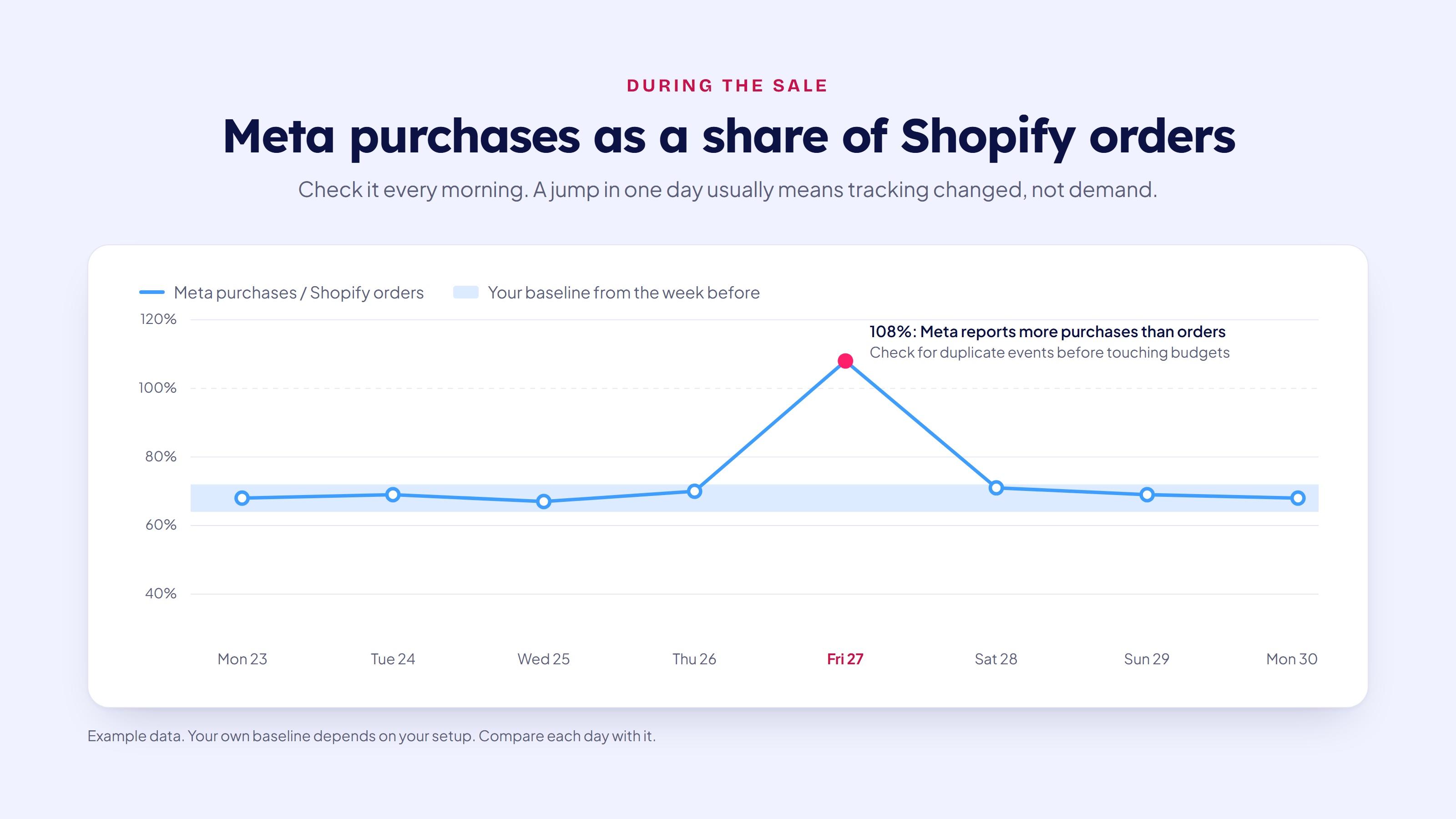
If a platform's ratio to Shopify jumps in one day, check tracking first. Demand rarely changes that fast. Duplicate events push platform numbers up, missing events push them down. Our post on Meta conversions that don't match Shopify walks through the usual causes.
Add the platforms up, then compare with Shopify. Meta, Google, TikTok and Klaviyo can each claim the same order. If the sum is far above Shopify revenue, use MER to judge the sale as a whole.
Don't cut campaigns on one bad day. Many shoppers click on Friday and buy on Monday, and conversions arrive in ad platforms with a delay. Judge over two or three days where you can.
After the sale
The week after (1 to 7 December): start a post-purchase flow for first-time BFCM buyers, and add all BFCM buyers to your exclusion lists so December prospecting doesn't spend money on people who just bought. With TrackBee's Custom Audience Sync that list updates itself.
Mid-December: once most refunds are in, recalculate ROAS and MER on net revenue, and divide your BFCM ad spend by the number of first-time buyers. That is your real BFCM acquisition cost, and a better planning number for next year than four-day ROAS. If platforms reported far fewer purchases than you had orders, your ads probably did better than they showed, and the algorithms spent your biggest week learning from partial data.
The checklist, by hand or with TrackBee
| What your tracking needs | By hand | With TrackBee |
|---|---|---|
| Every purchase reaches Meta, Google, TikTok, Pinterest, GA4 & Klaviyo | Set up CAPI, Events API and enhanced conversions per platform | Sent server-side to all of them from one Shopify app |
| Each order counted once | Match event IDs between pixel and server per platform | Built-in deduplication |
| Platforms recognize the buyer | Pass hashed email, phone and click IDs per platform | Every event enriched with first-party data, plus persistent shopper profiles |
| New vs returning buyers | Upload customer lists and keep them current | New vs returning signal on every purchase, Custom Audience Sync |
| Klaviyo catches anonymous visitors | Limited to visitors Klaviyo can identify | Enriched profiles, so more visitors enter abandonment flows |
| Setup time | Developer work, per platform | Under five minutes, no developer |
Frequently asked questions
What does BFCM stand for? BFCM stands for Black Friday Cyber Monday: the four days from Black Friday to Cyber Monday. In 2026 that is Friday 27 November to Monday 30 November.
Is it too late to change my tracking before Black Friday? No. A server-side app like TrackBee takes under five minutes to install and runs next to your existing pixels. Set it up by 24 November and your ad platforms get a few days of complete data before the sale.
What should I check in my tracking before Black Friday? Place a test order with a discount code and check that it arrives in every ad platform, GA4 and Klaviyo with the right value, counted once. Then compare last week's platform conversions with Shopify orders. A big gap means your platforms are missing purchases.
Why do my ad platforms report fewer purchases than Shopify? Browser pixels miss around 30-60% of conversions because of ad blockers, iOS privacy rules and declined cookie banners. Server-side tracking sends those purchases from your store's backend, so the platforms still receive them.
How do I know if my BFCM campaigns are profitable? Compare each campaign's ROAS with your break-even ROAS at the discount you run, not your normal target. A 25% discount on a product with a 60% margin raises break-even ROAS from about 1.67 to about 2.14. Check MER for the sale as a whole.
When should I review my BFCM results? Look at daily numbers during the sale, and do the final review two to three weeks after Cyber Monday, once most refunds and cancellations are in.
Get your tracking ready before Black Friday
TrackBee sends each Shopify event server-side, enriches it with first-party data and deduplicates it against your pixel, for Meta, Google, TikTok, Pinterest, GA4 & Klaviyo. It tells your platforms who is new, keeps your audiences up to date and gets more visitors into your Klaviyo flows. Install it this week and your platforms go into Black Friday with complete data.
Read next: Black Friday Facebook ads | Marketing efficiency ratio | How to calculate ROAS