
Customer retention starts before the second purchase

How Shopify brands can use customer service conversations to identify friction, protect repeat revenue, and improve the experience after checkout.
November 18, 2026
David Smith
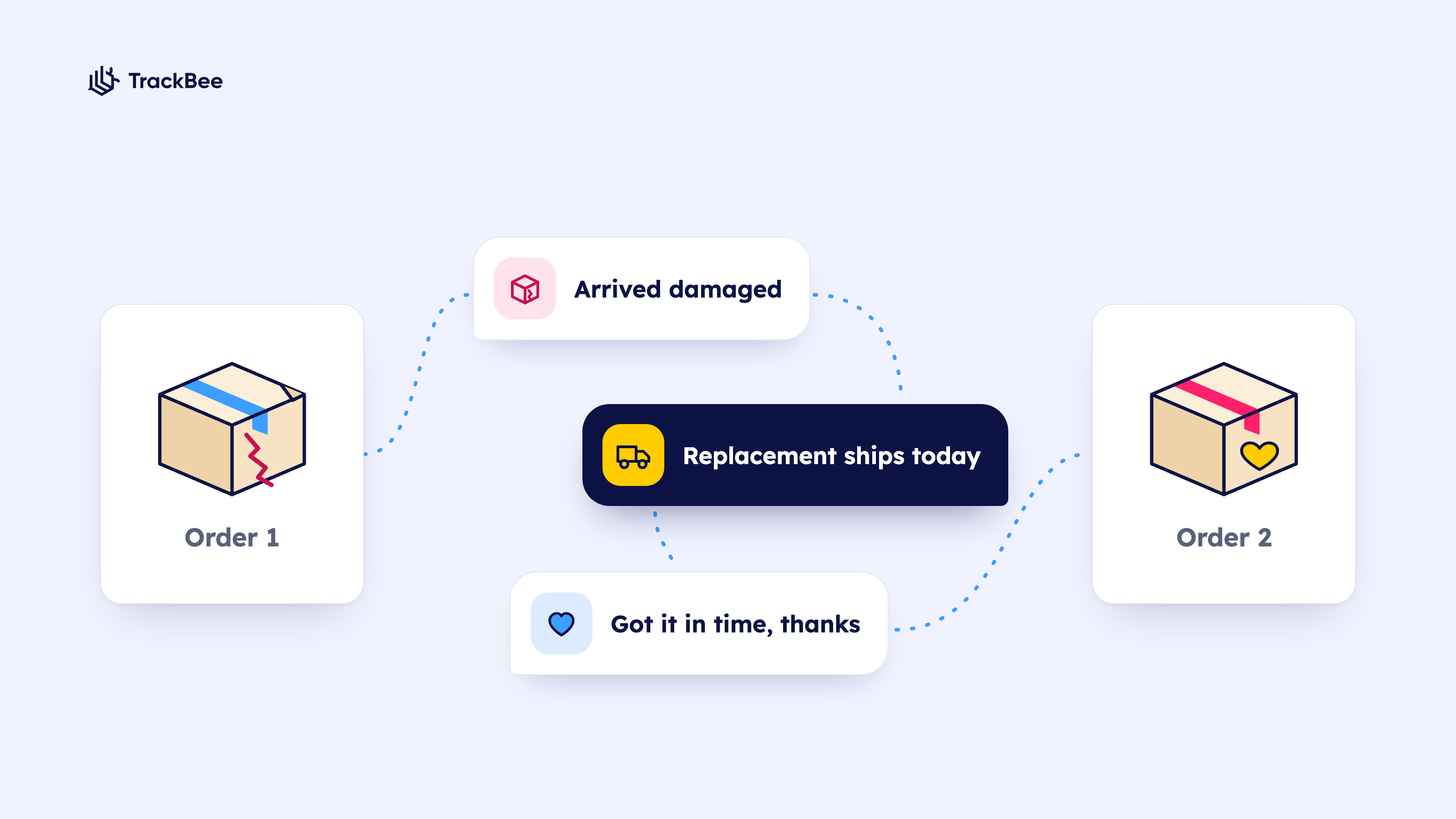
A damaged first order, a support conversation that fixes it, and a second order from the same customer
Latest
Shopify

Customer retention starts before the second purchase

A damaged first order, a support conversation that fixes it, and a second order from the same customer

TL;DR

  • Your support inbox shows where customers get stuck after checkout, often before it shows up in your repeat-purchase numbers.
  • Track contact rate (inquiries per 1,000 orders) instead of ticket volume, and judge support on whether problems get solved: first contact resolution, repeat contact rate and reopen rate.
  • Automate the routine questions, but let a person handle the ones that need judgment.
  • Match support history to your Shopify orders to see which support outcomes come before a second purchase, then fix one recurring problem and measure the result.

You spent money bringing a customer to your Shopify store. They clicked an ad, placed an order, and your acquisition dashboard recorded a conversion. But the work that determines whether they’ll buy again is only beginning. Customer retention isn’t just about better follow-up emails or another promotion. It’s also about what happens when a delivery goes wrong, a product disappoints, or someone needs help. And much of that information is already sitting inside your customer service operation.

The first purchase is only the beginning

Ecommerce marketers spend an extraordinary amount of time thinking about acquisition. Customer acquisition cost (CAC), return on ad spend (ROAS), average order value (AOV), and conversion rate all help answer an important question: how efficiently can you bring customers into the business? But those measurements don’t tell you much about what happens afterward.

Consider two customers who each make a $100 purchase after costing $40 to acquire. The first never buys again. The second makes three additional purchases over the next year. The acquisition cost was identical. The first-order revenue was identical. Yet the long-term economics of those relationships are very different. That’s why customer lifetime value (LTV) deserves a place alongside acquisition metrics.

TrackBee has explored the importance of separating new and returning customers in its guide to optimizing conversions for new customers. It’s an important distinction because acquisition performance and repeat-purchase performance answer different business questions. But once you can identify returning customers, another question becomes interesting. What happened between their first and second purchases? For many brands, part of that answer is hiding in customer service.

Your support team sees problems before your dashboard does

Think about the information your customer service team receives during an ordinary week. A customer asks why an order hasn’t shipped. Another can’t understand the sizing chart. Someone reports that a product arrived damaged. A subscriber wants to cancel because the delivery schedule no longer works. Individually, these look like support tickets. Collectively, they can tell you quite a bit about how your business is operating.

A sudden increase in shipping inquiries might reveal a fulfillment problem. Repeated sizing questions might suggest that a product page is creating uncertainty. Subscription cancellations might expose an issue with pricing, delivery frequency, or customer expectations.

This is one of the more overlooked advantages of a capable customer experience (CX) operation. Your support team isn’t simply resolving problems. It’s receiving direct feedback from people who have already spent money with you. The challenge is turning that information into something useful.

Start with contact rate

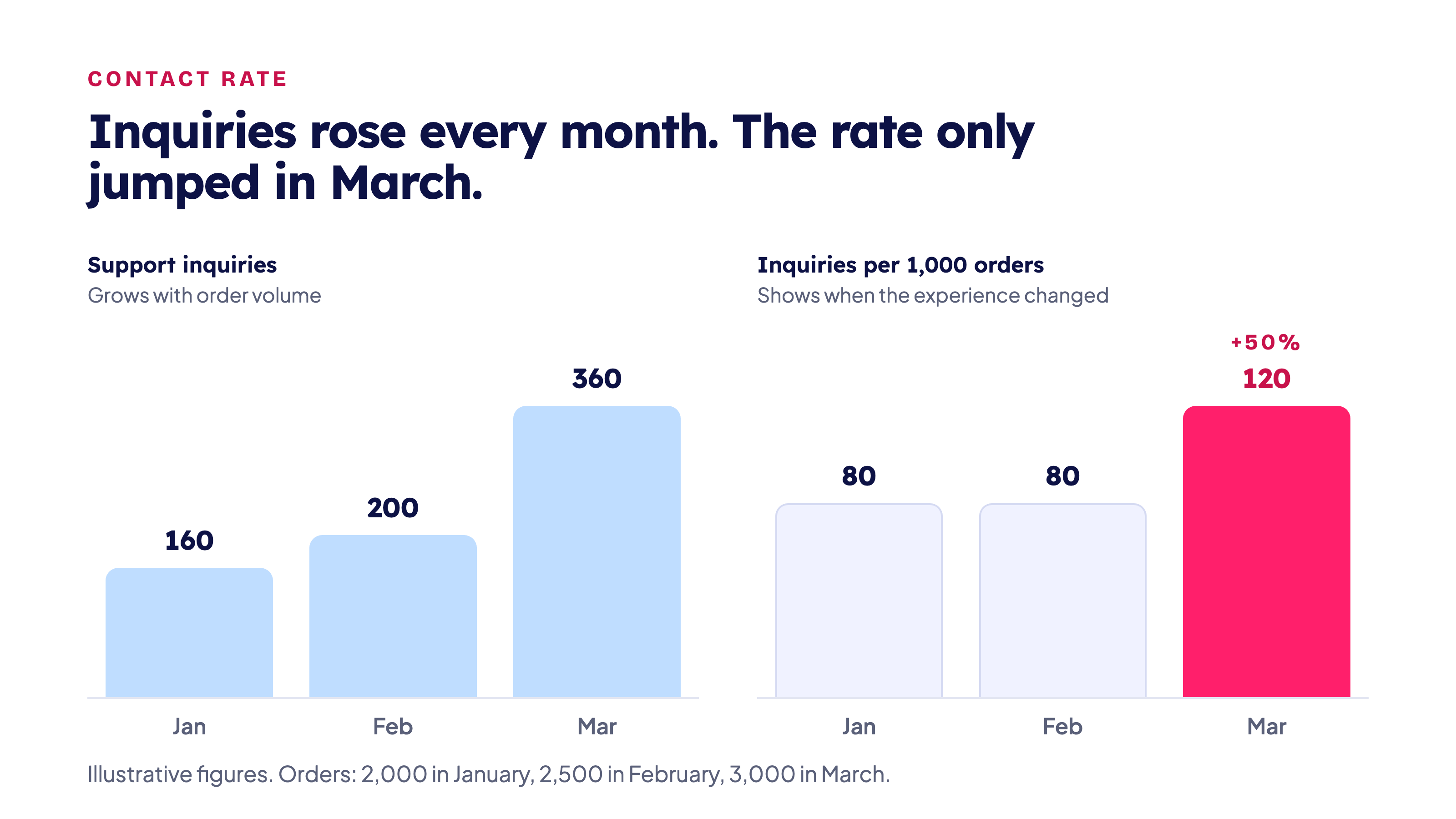
Ticket volume matters for staffing, but it doesn’t always reveal whether the customer experience is improving. If your store doubles its order volume, you should probably expect more support inquiries. Contact rate provides a better comparison by measuring support demand relative to orders or customers.

Consider this example:

MonthOrdersSupport inquiriesInquiries per 1,000 orders
January2,00016080
February2,50020080
March3,000360120

Illustrative figures.

Support inquiries rose from 160 to 360 between January and March, while inquiries per 1,000 orders stayed at 80 and then jumped 50% to 120 in March

Support volume increased every month. But the important change happened in March, when the rate of inquiries increased by 50%. Something may have changed in the customer experience. Perhaps a new product is generating confusion, a fulfillment partner is missing delivery expectations, or a returns policy has become harder to understand. You won’t know until you examine the conversations. But now you know where to look.

Not every customer conversation should be avoided

There’s an understandable push toward automation in customer service. AI can retrieve tracking information, answer routine questions, search product documentation, and prepare responses faster than someone working manually. Those capabilities are valuable. If a customer simply needs a tracking number, making them wait for an agent doesn’t improve the experience.

But businesses should be careful about treating every conversation that reaches a human as an inefficiency. The industry often measures automation through deflection rate, which generally describes the proportion of support demand handled without human involvement. Definitions vary between platforms. Higher deflection can reduce workload and costs. It doesn’t necessarily mean the customer experience improved.

Consider two messages:

“Where is my order?”

And:

“Where is my order? This is the third time I’ve contacted you, and I needed it for an event yesterday.”
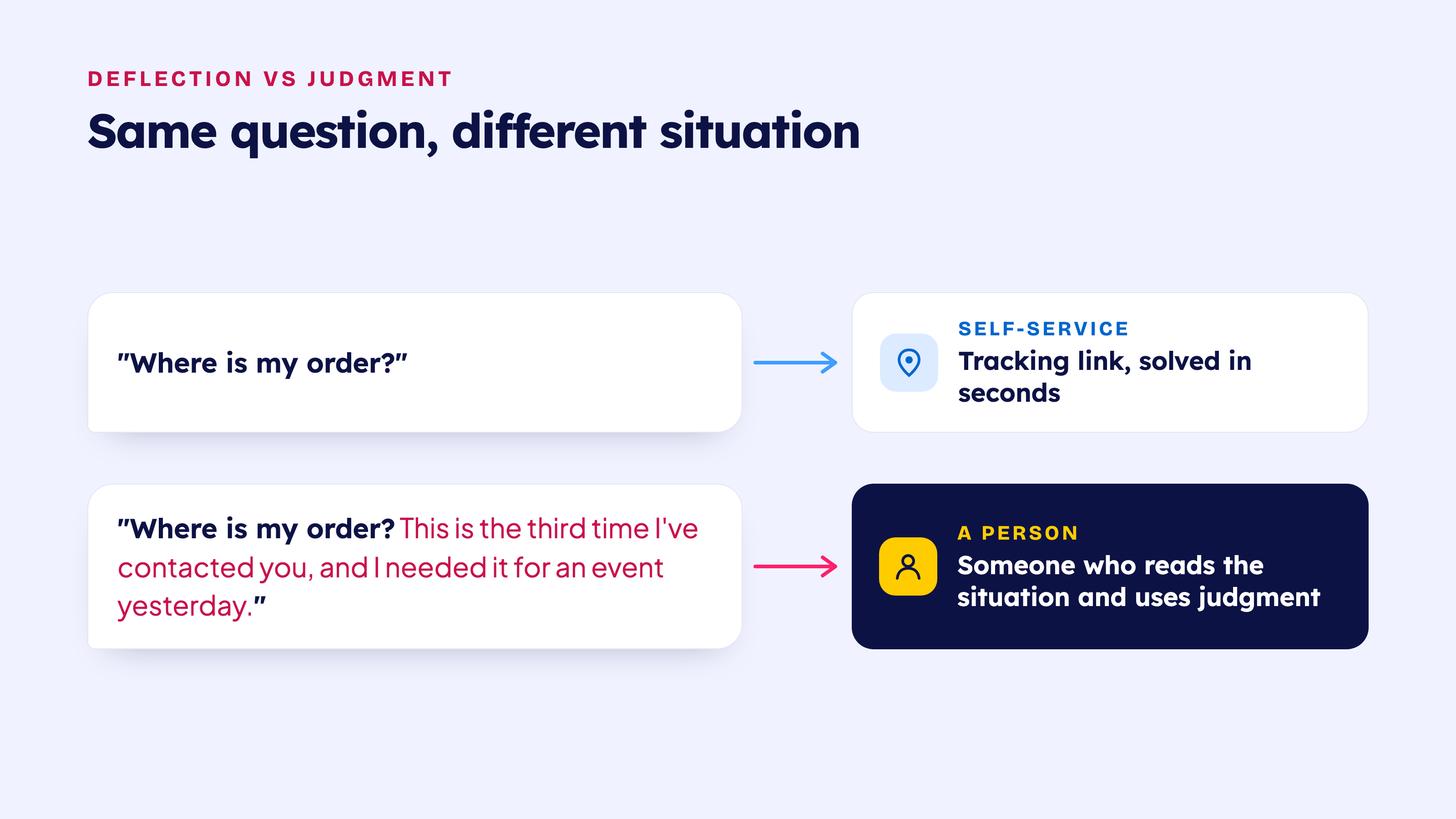
The same question, Where is my order, goes to self-service when it is routine and to a person who can use judgment when the customer has contacted support three times and missed an event

The subject is essentially the same. The customer’s situation isn’t. The first inquiry might be resolved perfectly through self-service. The second may require someone capable of understanding the circumstances and exercising judgment. A business that optimizes exclusively for fewer human conversations risks missing that distinction. And those missed distinctions can have consequences for customer retention.

The conversation may be worth more than its cost

Imagine a repeat customer contacting your store about a disappointing order. An automated system might provide the correct return instructions and close the ticket. That may be sufficient. But an experienced support professional might recognize that the customer has purchased regularly for two years, understand why this order was disappointing, and offer a more appropriate resolution. The second interaction may take longer. It may also give the customer a reason to continue buying.

That doesn’t mean every dissatisfied customer needs a discount, or that longer conversations automatically produce better outcomes. It means the value of a support interaction isn’t always captured by how quickly it was closed. Sometimes the commercial benefit is a prevented cancellation, a resolved misunderstanding, or a customer who remains confident enough to purchase again.

Connect support outcomes with repeat purchases

Here’s where things become useful for a Shopify operator. You already have customer order information. Your support system should also have conversation histories, issue categories, and resolution details. Bringing those records together allows you to ask questions neither dataset can answer independently. Do customers whose issues are resolved in one interaction purchase again more frequently than those who need repeated follow-ups? Are customers contacting support about shipping problems less likely to place another order? Do customers who receive a replacement behave differently from those who receive a refund? These aren’t simply questions for a support manager.

They’re questions about retention, product experience, and the effectiveness of your customer journey.

A practical example

Suppose you review 300 customers who contacted support after purchasing. You divide them into three groups based on their support outcomes.

Support outcomeCustomersRepeat purchase rate within 90 days
Resolved in one contact10032%
Required multiple contacts10021%
Ticket reopened10014%

Hypothetical example, not industry benchmark data.
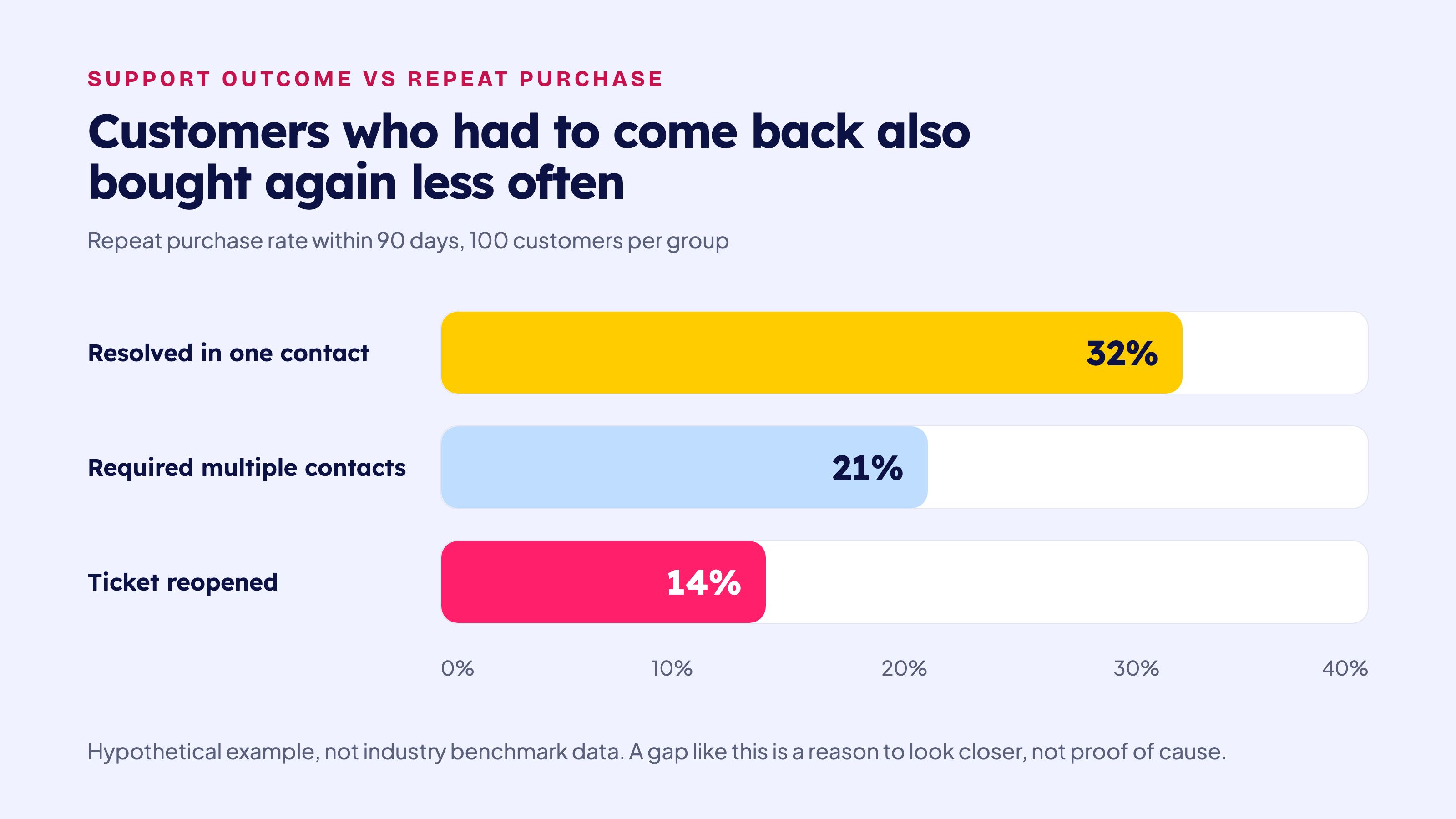
Repeat purchase rate within 90 days by support outcome: 32% when resolved in one contact, 21% after multiple contacts, 14% when the ticket was reopened. Hypothetical example

That’s a difference worth investigating. It doesn’t prove that better resolution caused the additional purchases. Customers with more complicated issues may have experienced more serious product problems. Their purchasing habits may also differ. But it suggests that repeated support friction deserves attention.

Now you have a reason to examine those interactions, identify recurring problems, and test improvements. You’ve moved from asking how quickly tickets were closed to asking what happened to the customer relationship afterward. That’s a much more interesting business conversation.

Measure resolution quality, not just speed

Support teams commonly track first response time, average handle time, and resolution time. These are legitimate operational measurements. But if retention is part of the objective, they need context.

  • First contact resolution (FCR) measures whether an issue was resolved during the first interaction, without requiring further contact.
  • Repeat contact rate helps identify customers who return with the same or a related issue.
  • Reopen rate tracks conversations that become active again after being marked resolved.

Together, these measurements provide a better picture of whether problems are actually being solved. A ticket closed in four minutes looks efficient until the customer writes back twice and eventually requests a refund. A twelve-minute conversation that solves the underlying problem may be considerably more economical. The goal isn’t to find one perfect metric. It’s to understand what those measurements reveal about the customer experience, and what happens afterward.

Better information makes better CX possible

There’s a practical problem when businesses try to connect customer service with retention. The information is often scattered. The conversation is in the helpdesk. The order history is in Shopify. Subscription details are in another application. Previous complaints might be buried in an email thread. And marketing is looking at an entirely different dashboard. That makes support harder for the people doing the work and analysis harder for the people running the business.

At HumanTouch CX, we’re building a Shopify-native helpdesk around the idea that customer conversations and order context belong together. Hewie, our AI assistant, helps support professionals retrieve information and prepare responses, while verified humans remain responsible for what reaches the customer.
The HumanTouch CX homepage: a Shopify-native helpdesk where verified humans help and AI supports

The broader principle is straightforward. Use technology to reduce the mechanical work surrounding customer service, so capable people can spend more time understanding and resolving the issues that matter. And preserve the information needed to understand those interactions later.

Retention problems often start outside customer service

One of the biggest mistakes a growing ecommerce brand can make is assuming that improving customer service means asking the support team to work harder. Sometimes the best improvement happens elsewhere. If customers repeatedly ask about shipping delays, the solution might be better fulfillment. If product compatibility questions keep appearing, the solution might be clearer product descriptions. If subscribers are confused about renewals, the solution might involve checkout messaging or better reminder emails. And if customers regularly contact support after seeing an advertisement, perhaps the ad is creating expectations the product doesn’t meet. This is where CX information becomes valuable to the wider business.

Marketing can improve messaging. Merchandising can improve product information. Operations can identify recurring delivery issues. TrackBee’s guide to ecommerce metrics that actually move your store discusses the importance of understanding the relationship between acquisition, revenue, and returning customers.

I’d extend that thinking one step further. Once you know which customers are returning, start examining what happened between their purchases. Not every repeat purchase can be credited to customer service, just as every lost customer can’t be blamed on it. But those interactions are part of the customer journey. Leaving them out means evaluating retention without examining one of the places where customer relationships are most directly tested.

What to do this week

You don’t need a complicated attribution model to start learning from your support conversations.

Begin with one manageable exercise.

  • Choose a customer cohort. Start with customers who placed their first order 90 to 180 days ago, preferably within a product category with a realistic repeat-purchase cycle.
  • Review their support history. Identify who contacted support, what the issue involved, and whether it was resolved in one interaction or required follow-up.
  • Match support records to Shopify orders. Examine subsequent purchases using consistent customer identifiers and comparable follow-up periods.
  • Compare similar customers. Look at repeat-purchase behavior across different support outcomes, accounting for differences in product category and issue severity where possible.
  • Fix one recurring problem. Choose something actionable, whether that’s shipping communication, product information, or a confusing returns process. Then measure the results.

You may discover that your support operation is already doing an excellent job. You may discover that a small operational problem is creating more customer frustration than anyone realized. Or you may find that your biggest retention opportunity isn’t another email campaign or a larger advertising budget.

It’s fixing something customers have been telling you about for months. Customer retention doesn’t begin when someone receives a win-back offer. It begins with the experience they have after deciding to trust your business with their first purchase. And sometimes, the most useful information about whether they’ll buy again is sitting in a conversation your support team had yesterday.


Read next: How to optimize conversions for new customers | Ecommerce metrics to track | Marketing efficiency ratio

In this article
Boost Your Revenue
Track Missing Conversion Data
Lorem Ipsum

Boost Your Revenue

Track & Enrich
Missing Conversion Data

Try for free
Share this:

TL;DR

  • Your support inbox shows where customers get stuck after checkout, often before it shows up in your repeat-purchase numbers.
  • Track contact rate (inquiries per 1,000 orders) instead of ticket volume, and judge support on whether problems get solved: first contact resolution, repeat contact rate and reopen rate.
  • Automate the routine questions, but let a person handle the ones that need judgment.
  • Match support history to your Shopify orders to see which support outcomes come before a second purchase, then fix one recurring problem and measure the result.

You spent money bringing a customer to your Shopify store. They clicked an ad, placed an order, and your acquisition dashboard recorded a conversion. But the work that determines whether they’ll buy again is only beginning. Customer retention isn’t just about better follow-up emails or another promotion. It’s also about what happens when a delivery goes wrong, a product disappoints, or someone needs help. And much of that information is already sitting inside your customer service operation.

The first purchase is only the beginning

Ecommerce marketers spend an extraordinary amount of time thinking about acquisition. Customer acquisition cost (CAC), return on ad spend (ROAS), average order value (AOV), and conversion rate all help answer an important question: how efficiently can you bring customers into the business? But those measurements don’t tell you much about what happens afterward.

Consider two customers who each make a $100 purchase after costing $40 to acquire. The first never buys again. The second makes three additional purchases over the next year. The acquisition cost was identical. The first-order revenue was identical. Yet the long-term economics of those relationships are very different. That’s why customer lifetime value (LTV) deserves a place alongside acquisition metrics.

TrackBee has explored the importance of separating new and returning customers in its guide to optimizing conversions for new customers. It’s an important distinction because acquisition performance and repeat-purchase performance answer different business questions. But once you can identify returning customers, another question becomes interesting. What happened between their first and second purchases? For many brands, part of that answer is hiding in customer service.

Your support team sees problems before your dashboard does

Think about the information your customer service team receives during an ordinary week. A customer asks why an order hasn’t shipped. Another can’t understand the sizing chart. Someone reports that a product arrived damaged. A subscriber wants to cancel because the delivery schedule no longer works. Individually, these look like support tickets. Collectively, they can tell you quite a bit about how your business is operating.

A sudden increase in shipping inquiries might reveal a fulfillment problem. Repeated sizing questions might suggest that a product page is creating uncertainty. Subscription cancellations might expose an issue with pricing, delivery frequency, or customer expectations.

This is one of the more overlooked advantages of a capable customer experience (CX) operation. Your support team isn’t simply resolving problems. It’s receiving direct feedback from people who have already spent money with you. The challenge is turning that information into something useful.

Start with contact rate

Ticket volume matters for staffing, but it doesn’t always reveal whether the customer experience is improving. If your store doubles its order volume, you should probably expect more support inquiries. Contact rate provides a better comparison by measuring support demand relative to orders or customers.

Consider this example:

MonthOrdersSupport inquiriesInquiries per 1,000 orders
January2,00016080
February2,50020080
March3,000360120

Illustrative figures.

Support inquiries rose from 160 to 360 between January and March, while inquiries per 1,000 orders stayed at 80 and then jumped 50% to 120 in March

Support volume increased every month. But the important change happened in March, when the rate of inquiries increased by 50%. Something may have changed in the customer experience. Perhaps a new product is generating confusion, a fulfillment partner is missing delivery expectations, or a returns policy has become harder to understand. You won’t know until you examine the conversations. But now you know where to look.

Not every customer conversation should be avoided

There’s an understandable push toward automation in customer service. AI can retrieve tracking information, answer routine questions, search product documentation, and prepare responses faster than someone working manually. Those capabilities are valuable. If a customer simply needs a tracking number, making them wait for an agent doesn’t improve the experience.

But businesses should be careful about treating every conversation that reaches a human as an inefficiency. The industry often measures automation through deflection rate, which generally describes the proportion of support demand handled without human involvement. Definitions vary between platforms. Higher deflection can reduce workload and costs. It doesn’t necessarily mean the customer experience improved.

Consider two messages:

“Where is my order?”

And:

“Where is my order? This is the third time I’ve contacted you, and I needed it for an event yesterday.”

The same question, Where is my order, goes to self-service when it is routine and to a person who can use judgment when the customer has contacted support three times and missed an event

The subject is essentially the same. The customer’s situation isn’t. The first inquiry might be resolved perfectly through self-service. The second may require someone capable of understanding the circumstances and exercising judgment. A business that optimizes exclusively for fewer human conversations risks missing that distinction. And those missed distinctions can have consequences for customer retention.

The conversation may be worth more than its cost

Imagine a repeat customer contacting your store about a disappointing order. An automated system might provide the correct return instructions and close the ticket. That may be sufficient. But an experienced support professional might recognize that the customer has purchased regularly for two years, understand why this order was disappointing, and offer a more appropriate resolution. The second interaction may take longer. It may also give the customer a reason to continue buying.

That doesn’t mean every dissatisfied customer needs a discount, or that longer conversations automatically produce better outcomes. It means the value of a support interaction isn’t always captured by how quickly it was closed. Sometimes the commercial benefit is a prevented cancellation, a resolved misunderstanding, or a customer who remains confident enough to purchase again.

Connect support outcomes with repeat purchases

Here’s where things become useful for a Shopify operator. You already have customer order information. Your support system should also have conversation histories, issue categories, and resolution details. Bringing those records together allows you to ask questions neither dataset can answer independently. Do customers whose issues are resolved in one interaction purchase again more frequently than those who need repeated follow-ups? Are customers contacting support about shipping problems less likely to place another order? Do customers who receive a replacement behave differently from those who receive a refund? These aren’t simply questions for a support manager.

They’re questions about retention, product experience, and the effectiveness of your customer journey.

A practical example

Suppose you review 300 customers who contacted support after purchasing. You divide them into three groups based on their support outcomes.

Support outcomeCustomersRepeat purchase rate within 90 days
Resolved in one contact10032%
Required multiple contacts10021%
Ticket reopened10014%

Hypothetical example, not industry benchmark data.

Repeat purchase rate within 90 days by support outcome: 32% when resolved in one contact, 21% after multiple contacts, 14% when the ticket was reopened. Hypothetical example

That’s a difference worth investigating. It doesn’t prove that better resolution caused the additional purchases. Customers with more complicated issues may have experienced more serious product problems. Their purchasing habits may also differ. But it suggests that repeated support friction deserves attention.

Now you have a reason to examine those interactions, identify recurring problems, and test improvements. You’ve moved from asking how quickly tickets were closed to asking what happened to the customer relationship afterward. That’s a much more interesting business conversation.

Measure resolution quality, not just speed

Support teams commonly track first response time, average handle time, and resolution time. These are legitimate operational measurements. But if retention is part of the objective, they need context.

  • First contact resolution (FCR) measures whether an issue was resolved during the first interaction, without requiring further contact.
  • Repeat contact rate helps identify customers who return with the same or a related issue.
  • Reopen rate tracks conversations that become active again after being marked resolved.

Together, these measurements provide a better picture of whether problems are actually being solved. A ticket closed in four minutes looks efficient until the customer writes back twice and eventually requests a refund. A twelve-minute conversation that solves the underlying problem may be considerably more economical. The goal isn’t to find one perfect metric. It’s to understand what those measurements reveal about the customer experience, and what happens afterward.

Better information makes better CX possible

There’s a practical problem when businesses try to connect customer service with retention. The information is often scattered. The conversation is in the helpdesk. The order history is in Shopify. Subscription details are in another application. Previous complaints might be buried in an email thread. And marketing is looking at an entirely different dashboard. That makes support harder for the people doing the work and analysis harder for the people running the business.

At HumanTouch CX, we’re building a Shopify-native helpdesk around the idea that customer conversations and order context belong together. Hewie, our AI assistant, helps support professionals retrieve information and prepare responses, while verified humans remain responsible for what reaches the customer.

The HumanTouch CX homepage: a Shopify-native helpdesk where verified humans help and AI supports

The broader principle is straightforward. Use technology to reduce the mechanical work surrounding customer service, so capable people can spend more time understanding and resolving the issues that matter. And preserve the information needed to understand those interactions later.

Retention problems often start outside customer service

One of the biggest mistakes a growing ecommerce brand can make is assuming that improving customer service means asking the support team to work harder. Sometimes the best improvement happens elsewhere. If customers repeatedly ask about shipping delays, the solution might be better fulfillment. If product compatibility questions keep appearing, the solution might be clearer product descriptions. If subscribers are confused about renewals, the solution might involve checkout messaging or better reminder emails. And if customers regularly contact support after seeing an advertisement, perhaps the ad is creating expectations the product doesn’t meet. This is where CX information becomes valuable to the wider business.

Marketing can improve messaging. Merchandising can improve product information. Operations can identify recurring delivery issues. TrackBee’s guide to ecommerce metrics that actually move your store discusses the importance of understanding the relationship between acquisition, revenue, and returning customers.

I’d extend that thinking one step further. Once you know which customers are returning, start examining what happened between their purchases. Not every repeat purchase can be credited to customer service, just as every lost customer can’t be blamed on it. But those interactions are part of the customer journey. Leaving them out means evaluating retention without examining one of the places where customer relationships are most directly tested.

What to do this week

You don’t need a complicated attribution model to start learning from your support conversations.

Begin with one manageable exercise.

  • Choose a customer cohort. Start with customers who placed their first order 90 to 180 days ago, preferably within a product category with a realistic repeat-purchase cycle.
  • Review their support history. Identify who contacted support, what the issue involved, and whether it was resolved in one interaction or required follow-up.
  • Match support records to Shopify orders. Examine subsequent purchases using consistent customer identifiers and comparable follow-up periods.
  • Compare similar customers. Look at repeat-purchase behavior across different support outcomes, accounting for differences in product category and issue severity where possible.
  • Fix one recurring problem. Choose something actionable, whether that’s shipping communication, product information, or a confusing returns process. Then measure the results.

You may discover that your support operation is already doing an excellent job. You may discover that a small operational problem is creating more customer frustration than anyone realized. Or you may find that your biggest retention opportunity isn’t another email campaign or a larger advertising budget.

It’s fixing something customers have been telling you about for months. Customer retention doesn’t begin when someone receives a win-back offer. It begins with the experience they have after deciding to trust your business with their first purchase. And sometimes, the most useful information about whether they’ll buy again is sitting in a conversation your support team had yesterday.


Read next: How to optimize conversions for new customers | Ecommerce metrics to track | Marketing efficiency ratio

Latest

Discover other Blogs

Explore our collection of informative and engaging blog posts.

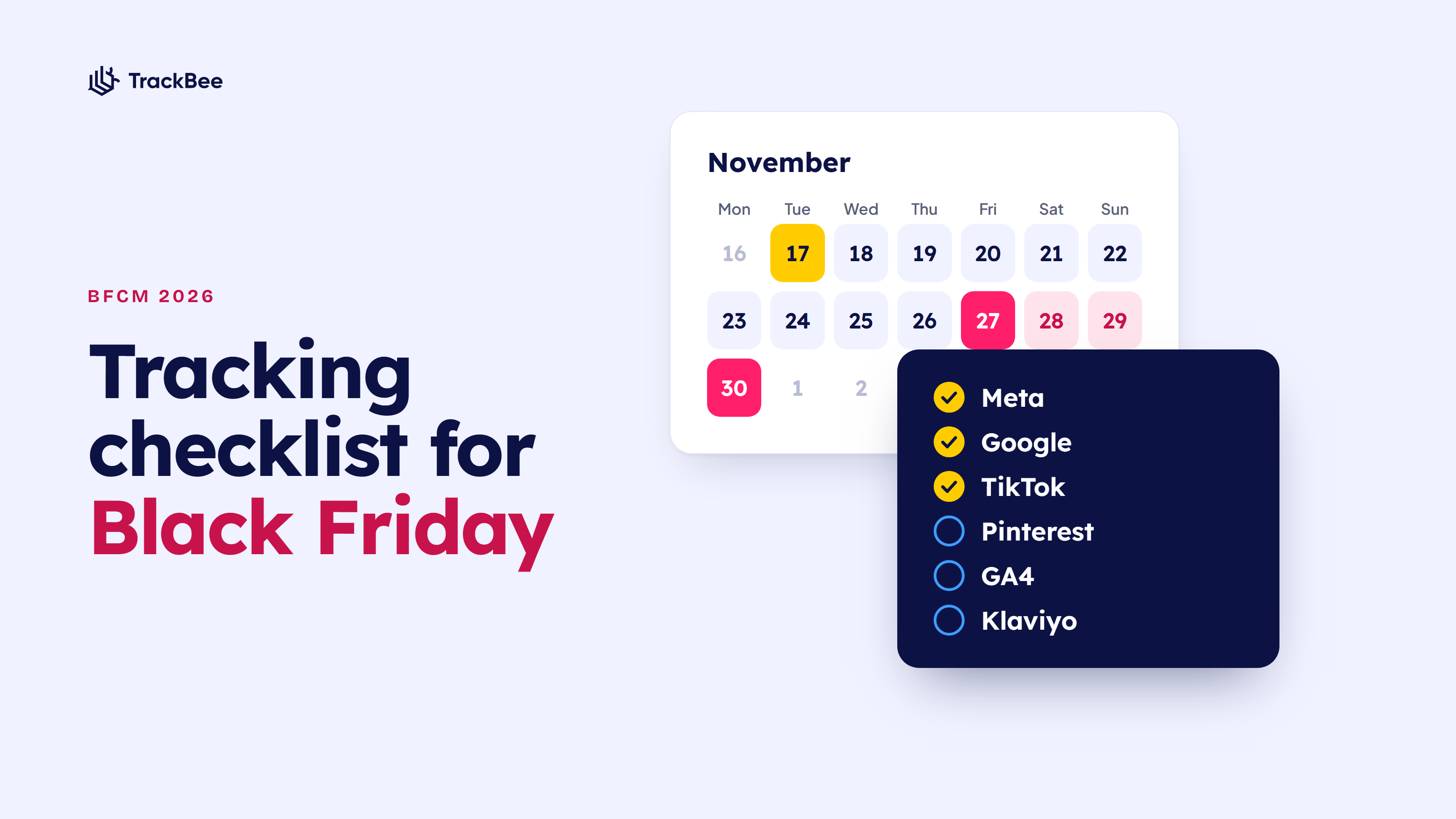
BFCM 2026 tracking checklist: November calendar with Black Friday and Cyber Monday marked, next to a checklist for Meta, Google, TikTok, Pinterest, GA4 and Klaviyo
Frank de Vos
Frank de Vos
8
min read
Break-even ROAS for a $100 product with $40 cost: 1.67 at full price, 2.14 at 25% off, 3.00 at 40% off
Frank de Vos
Frank de Vos
9
min read
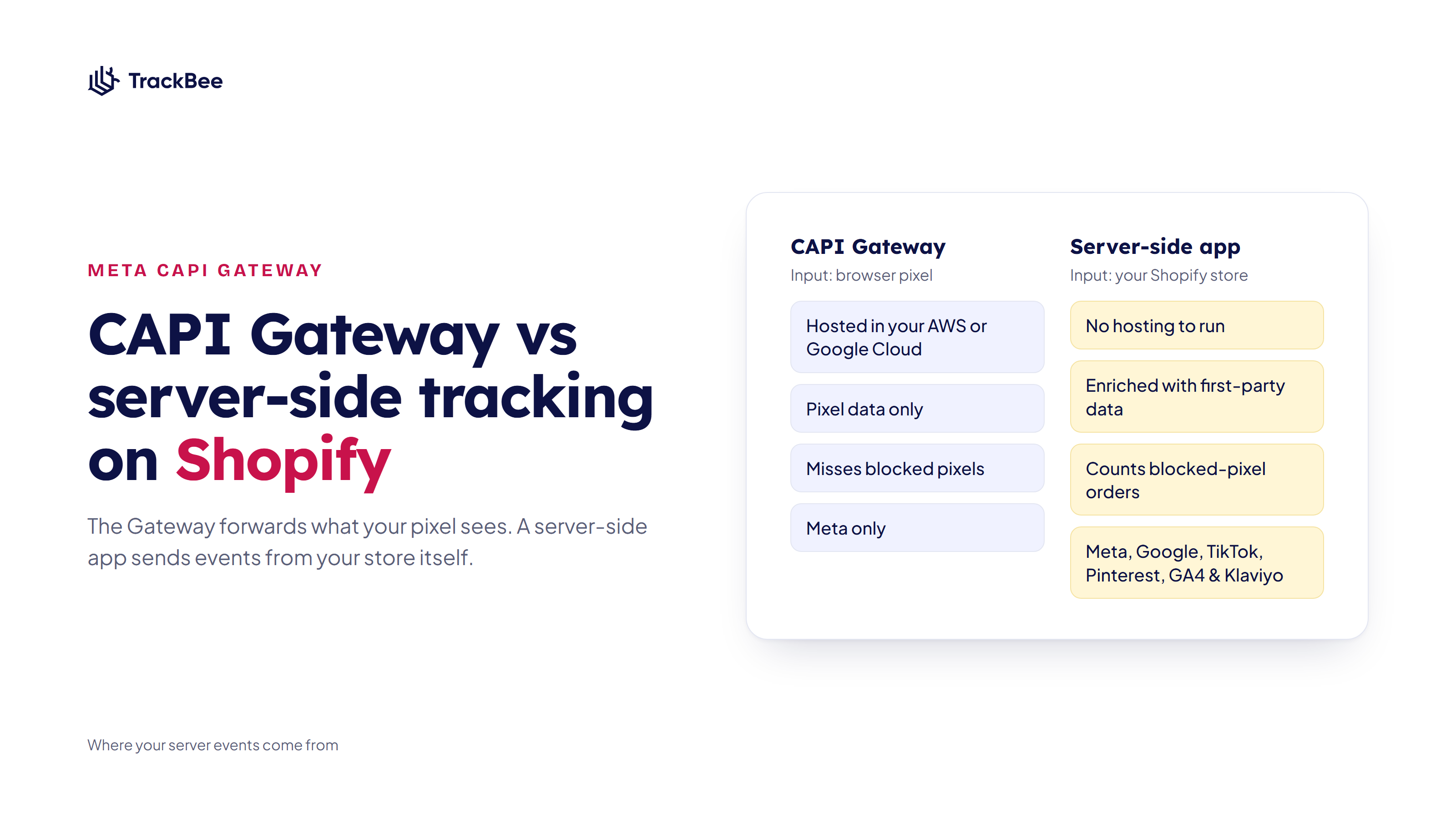
Meta CAPI Gateway forwards browser pixel events; a server-side tracking app sends events from the Shopify store itself
Frank de Vos
Frank de Vos
9
min read