Meta Advantage+ Campaigns: The Data They Need to Perform (2026)

Meta Advantage+ sales campaigns (formerly Advantage+ shopping campaigns) learn from your conversion data. Here's what to feed them for better ROAS.
November 5, 2026
Frank de Vos
Feed Meta Advantage+ Better Data for Better ROAS
Latest
Meta Ads

Meta Advantage+ Campaigns: The Data They Need to Perform (2026)

Feed Meta Advantage+ Better Data for Better ROAS

Short answer: Meta Advantage+ hands targeting, placements and budget to Meta's AI, which learns from the conversion signals you send back. Advantage+ shopping campaigns are now called Advantage+ sales campaigns, but the rule hasn't changed: missing or poorly matched purchase events make the algorithm optimize toward the wrong people. Complete, server-side events enriched with first-party data fix that.

Meta Advantage+ changed how ecommerce brands run paid social. Instead of building audiences, choosing placements and testing combinations by hand, you let Meta's algorithm decide who sees which ad, where and at what budget.

For many Shopify brands that has been a relief: less time in Ads Manager and fewer audience tests. The catch is that an algorithm making every targeting decision depends completely on the data it learns from. When you give up the targeting controls, the conversion signal you send back is the main lever you have left.

This guide covers what Advantage+ looks like in 2026, what data it learns from, why most Shopify stores send too little of it, and how to fix that.

What Meta Advantage+ Is in 2026

The naming moved around in 2025, so a quick reset.

Advantage+ shopping campaigns became Advantage+ sales campaigns. In early 2025 Meta renamed Advantage+ shopping campaigns (often shortened to ASC) to Advantage+ sales campaigns and extended the same automated setup to the app and leads objectives (Jon Loomer).

Advantage+ is now a status, not a separate campaign type. When you create a campaign with the Sales, App or Leads objective, Advantage+ is on by default. The campaign keeps that status as long as three levers stay on:

  • Advantage+ audience: Meta decides who to reach. You can add audience suggestions, plus controls such as location, minimum age and excluded custom audiences.

  • Advantage+ placements: ads run across Meta's placements wherever they perform best.

  • Advantage+ campaign budget: budget moves between ad sets based on performance.

Customize one of these too far and the campaign loses its Advantage+ status.

The structure is more flexible than old ASC. Advantage+ shopping campaigns had a single ad set. Advantage+ sales campaigns allow multiple ad sets, with a limit of 50 ads per ad set, and add audience suggestions and custom audience exclusions. The old cap on budget for existing customers was dropped.

Meta's own Advantage+ overview is the official reference. Whatever the label, one thing stays the same: these campaigns learn from your conversion data.

Why Meta Advantage+ Depends on Your Data

In a manual campaign, your own targeting knowledge covers for gaps in the data. If your pixel misses a few purchases, you still reach the right people because you picked the audience.

With Advantage+ that safety net is gone. The algorithm learns from the conversion events and audience signals you provide. Browser pixels miss around 30-60% of conversions because of iOS restrictions, ad blockers and declined consent. When that happens, Advantage+ trains on a partial picture, and it has no way of knowing what is missing.

It is the same AI direction behind Meta's AI-driven ad personalization and the Andromeda retrieval system: more automation on Meta's side, more weight on the data you feed it.

The Four Data Inputs Behind Advantage+ Performance

Feed Meta Advantage+ Better Data for Better ROAS visual 2

1. Conversion Events

The core signals: PageView, ViewContent, AddToCart, InitiateCheckout and Purchase. Each completed action helps Meta build a picture of who converts and how they get there.

When events go missing (a blocked pixel, a stripped click ID, a declined banner), the algorithm has blind spots. Our complete guide to Meta CAPI for Shopify explains how server-side delivery closes them.

2. Audience Signals

Advantage+ audience accepts suggestions: custom audiences, lookalike sources and customer lists that tell the algorithm where to look first before it expands. They are hints, not hard limits. Advantage+ sales campaigns also let you exclude custom audiences, which is only as useful as the audience is complete and current.

3. Customer Value Data

A first-time buyer spending $200 is a different signal from a returning customer buying a $15 refill. When Meta can tell them apart, it can optimize for the outcomes that grow your business instead of raw conversion count. See our guide on optimizing conversions for new customers.

4. Creative Performance Data

Advantage+ tests creative combinations automatically. If a conversion is lost, the algorithm cannot connect it to the ad that drove it and misjudges which creatives work. That feeds straight into creative fatigue decisions too.

How Incomplete Data Hurts Advantage+ Campaigns

Feed Meta Advantage+ Better Data for Better ROAS visual 3

High-intent shoppers get underbid. A shopper browses three products, adds to cart and buys, but Safari's ITP and a blocker mean AddToCart and Purchase never reach Meta. Meta never learns that this kind of shopper converts, so next time it bids too low on someone similar.

Budget drifts to easy signals. When the algorithm sees too few real purchases, it leans on what it can see: clicks and landing page views. Spend moves toward people who click but don't buy.

Learning takes longer. Meta's learning phase guidance says an ad set needs roughly 50 optimization events within seven days to stabilize. If tracking misses a big share of your purchases, you need far more real sales to get there, and some ad sets never leave learning.

ROAS reporting gets shaky. If you cannot trust reported ROAS, scaling decisions turn into guesses. Brands cut campaigns that were profitable and scale ones that were not.

Put simply: when a platform gets less data, it generalizes more, and you pay for the wrong prospects more often.

Why Event Match Quality Matters More for Advantage+

Event Match Quality is Meta's 0 to 10 diagnostic score for how well your events can be matched to people on its platforms. Higher match quality means Meta can tie more of your purchases to the people who saw or clicked your ads.

For manual campaigns it matters. For Advantage+ it matters more, because targeting runs entirely on matched conversions. An unmatched purchase tells Meta a sale happened, but not who made it, so it cannot use that sale to find similar people.

More matched conversions mean faster learning, better lookalike modeling and sharper bids. To learn what drives the score, read our guide to improving Meta's Event Match Quality.

How Server-Side Tracking Closes the Data Gap

The root cause is that browser pixels are less reliable every year. Safari limits cookies and strips some click IDs, ad blockers stop pixels from loading, and consent banners gate tracking for a large share of visitors.

Server-side tracking through Meta's Conversions API sends events from your server to Meta without going through the browser. Blockers and script failures stop affecting your data.

A note on Meta's 2026 one-click Conversions API setup: it mirrors the events your pixel already sends through a server connection. That makes those events sturdier, but it cannot send events the pixel never fired, custom events or extra customer data. For Advantage+, the gains come from what you add to each event.

Data Enrichment: What Advantage+ Learns From

When TrackBee sends a purchase to Meta, it does not just send "Purchase, $150." It enriches it with first-party data:

  • Hashed email address

  • Hashed phone number

  • Hashed first and last name

  • Hashed address (city, state, zip, country)

  • External ID for cross-session matching

  • Meta click ID (fbc) when available

Meta uses these hashed identifiers to match events to people. More identifiers per event means a higher match rate.

TrackBee's persistent shopper profiles make that possible even for events that would normally be anonymous. Because returning visitors are recognized across sessions and devices, TrackBee can enrich events that a standard pixel would send with no identifiers at all. In TrackBee's own data, this raises Event Match Quality by 3-4 points on average. Our explainer on session enrichment shows how it works.

New vs. Returning Customer Signals for Advantage+

One of the biggest leaks in Advantage+ budgets is acquisition spend on people who already bought from you. Advantage+ sales campaigns now let you exclude custom audiences, but an exclusion list built from pixel data misses many of your customers.

TrackBee sends two separate purchase events to Meta:

  • NewCustomerPurchase for first-time buyers

  • ReturningCustomerPurchase for repeat buyers

What that gives you:

  1. A new-customer optimization target. Where your campaign setup allows custom conversions, optimize toward NewCustomerPurchase so the algorithm learns what first-time buyers look like.

  2. Better exclusions. Build exclusion audiences from returning-customer data so acquisition budget goes toward growth.

  3. Real acquisition numbers. Split new and returning revenue, so you see what new customers actually cost instead of a blended figure. (True CAC also includes your other sales and marketing costs.)

More detail in how to stop wasting Meta ad budget on returning customers.

Custom Audience Sync as an Advantage+ Input

TrackBee creates and maintains a "TrackBee - All Customers" custom audience in your Meta ad account and syncs it every 5-15 minutes.

For Advantage+ that audience does two jobs. As an audience suggestion it tells the algorithm: these are my customers, find more like them. As an exclusion it keeps recent buyers out of prospecting.

Because it is built from server-side data, it includes customers the pixel never saw: iOS buyers, people who declined cookies, people with blockers. A more complete seed audience means better lookalikes and faster learning.

What This Looks Like in Practice

Petrol Industries added TrackBee's server-side tracking and enrichment and saw a 100% increase in ROAS on Meta.

That kind of result comes from several improvements adding up:

  • More events reach Meta, because server-side delivery gets past blockers

  • Events carry more matching data, because hashed identifiers raise match quality

  • The algorithm trains on more matched conversions

  • New vs. returning signals cut wasted spend

  • A complete synced audience gives Advantage+ stronger seed data

None of it requires campaign structure tricks. You fix the data at the source. For the broader principle across platforms, read why AI bidding needs better data, and for growth on top of it, scaling Facebook ads without losing ROAS.

Getting Started: An Advantage+ Data Checklist

If you run Meta Advantage+ campaigns for a Shopify store, work through this list:

  1. Make sure events arrive server-side. The pixel alone is not enough for Advantage+. You need Conversions API coverage for every key event.

  2. Check Event Match Quality per event in Events Manager. Low scores on Purchase mean Meta cannot use many of your sales.

  3. Turn on enrichment. Events without hashed identifiers match poorly.

  4. Send new vs. returning signals, so Advantage+ can tell acquisition from retention.

  5. Sync a complete customer audience for suggestions and exclusions.

  6. Avoid double server streams. If you run a server-side tool, do not also switch on Meta's one-click CAPI or the Shopify app's higher data sharing levels.

TrackBee covers the first five for Shopify stores automatically, for Meta, Google, TikTok, Pinterest, GA4 & Klaviyo. Setup takes under five minutes and needs no developer. See the Meta integration for details.

Frequently Asked Questions

What is Meta Advantage+? Meta Advantage+ is Meta's set of AI-driven campaign tools. In a campaign with Advantage+ switched on, Meta automates audience, placements and budget, and in many cases creative variations too, based on the conversion data it receives.

Are Advantage+ shopping campaigns still available? Advantage+ shopping campaigns were renamed Advantage+ sales campaigns in 2025. New campaigns with the Sales objective start with Advantage+ on by default. Existing shopping campaigns may keep running, but Meta is moving everyone to the sales campaign setup.

How many conversions does an Advantage+ campaign need? Meta's learning phase guidance points to roughly 50 optimization events per ad set within seven days. Lost conversions make that harder to reach, which is why complete tracking matters so much for Advantage+.

Can I exclude existing customers from Advantage+ sales campaigns? Yes, Advantage+ sales campaigns support custom audience exclusions. The exclusion only works if the audience is complete and current, so a customer list synced from your store beats one built from pixel data.

Does Advantage+ work without the Conversions API? It runs, but it learns from whatever the pixel catches. With browser pixels missing a sizable share of conversions, Advantage+ optimizes on incomplete data. Server-side events with enrichment give it a much fuller picture.

Give Advantage+ Better Data

Advantage+ does the targeting. Your job is to make sure it learns from every real purchase, with enough data attached to know who made it.

Try TrackBee for free, or book a free demo.

In this article
Boost Your Revenue
Track Missing Conversion Data
Lorem Ipsum

Boost Your Revenue

Track & Enrich
Missing Conversion Data

Try for free
Share this:

Short answer: Meta Advantage+ hands targeting, placements and budget to Meta's AI, which learns from the conversion signals you send back. Advantage+ shopping campaigns are now called Advantage+ sales campaigns, but the rule hasn't changed: missing or poorly matched purchase events make the algorithm optimize toward the wrong people. Complete, server-side events enriched with first-party data fix that.

Meta Advantage+ changed how ecommerce brands run paid social. Instead of building audiences, choosing placements and testing combinations by hand, you let Meta's algorithm decide who sees which ad, where and at what budget.

For many Shopify brands that has been a relief: less time in Ads Manager and fewer audience tests. The catch is that an algorithm making every targeting decision depends completely on the data it learns from. When you give up the targeting controls, the conversion signal you send back is the main lever you have left.

This guide covers what Advantage+ looks like in 2026, what data it learns from, why most Shopify stores send too little of it, and how to fix that.

What Meta Advantage+ Is in 2026

The naming moved around in 2025, so a quick reset.

Advantage+ shopping campaigns became Advantage+ sales campaigns. In early 2025 Meta renamed Advantage+ shopping campaigns (often shortened to ASC) to Advantage+ sales campaigns and extended the same automated setup to the app and leads objectives (Jon Loomer).

Advantage+ is now a status, not a separate campaign type. When you create a campaign with the Sales, App or Leads objective, Advantage+ is on by default. The campaign keeps that status as long as three levers stay on:

  • Advantage+ audience: Meta decides who to reach. You can add audience suggestions, plus controls such as location, minimum age and excluded custom audiences.

  • Advantage+ placements: ads run across Meta's placements wherever they perform best.

  • Advantage+ campaign budget: budget moves between ad sets based on performance.

Customize one of these too far and the campaign loses its Advantage+ status.

The structure is more flexible than old ASC. Advantage+ shopping campaigns had a single ad set. Advantage+ sales campaigns allow multiple ad sets, with a limit of 50 ads per ad set, and add audience suggestions and custom audience exclusions. The old cap on budget for existing customers was dropped.

Meta's own Advantage+ overview is the official reference. Whatever the label, one thing stays the same: these campaigns learn from your conversion data.

Why Meta Advantage+ Depends on Your Data

In a manual campaign, your own targeting knowledge covers for gaps in the data. If your pixel misses a few purchases, you still reach the right people because you picked the audience.

With Advantage+ that safety net is gone. The algorithm learns from the conversion events and audience signals you provide. Browser pixels miss around 30-60% of conversions because of iOS restrictions, ad blockers and declined consent. When that happens, Advantage+ trains on a partial picture, and it has no way of knowing what is missing.

It is the same AI direction behind Meta's AI-driven ad personalization and the Andromeda retrieval system: more automation on Meta's side, more weight on the data you feed it.

The Four Data Inputs Behind Advantage+ Performance

Feed Meta Advantage+ Better Data for Better ROAS visual 2

1. Conversion Events

The core signals: PageView, ViewContent, AddToCart, InitiateCheckout and Purchase. Each completed action helps Meta build a picture of who converts and how they get there.

When events go missing (a blocked pixel, a stripped click ID, a declined banner), the algorithm has blind spots. Our complete guide to Meta CAPI for Shopify explains how server-side delivery closes them.

2. Audience Signals

Advantage+ audience accepts suggestions: custom audiences, lookalike sources and customer lists that tell the algorithm where to look first before it expands. They are hints, not hard limits. Advantage+ sales campaigns also let you exclude custom audiences, which is only as useful as the audience is complete and current.

3. Customer Value Data

A first-time buyer spending $200 is a different signal from a returning customer buying a $15 refill. When Meta can tell them apart, it can optimize for the outcomes that grow your business instead of raw conversion count. See our guide on optimizing conversions for new customers.

4. Creative Performance Data

Advantage+ tests creative combinations automatically. If a conversion is lost, the algorithm cannot connect it to the ad that drove it and misjudges which creatives work. That feeds straight into creative fatigue decisions too.

How Incomplete Data Hurts Advantage+ Campaigns

Feed Meta Advantage+ Better Data for Better ROAS visual 3

High-intent shoppers get underbid. A shopper browses three products, adds to cart and buys, but Safari's ITP and a blocker mean AddToCart and Purchase never reach Meta. Meta never learns that this kind of shopper converts, so next time it bids too low on someone similar.

Budget drifts to easy signals. When the algorithm sees too few real purchases, it leans on what it can see: clicks and landing page views. Spend moves toward people who click but don't buy.

Learning takes longer. Meta's learning phase guidance says an ad set needs roughly 50 optimization events within seven days to stabilize. If tracking misses a big share of your purchases, you need far more real sales to get there, and some ad sets never leave learning.

ROAS reporting gets shaky. If you cannot trust reported ROAS, scaling decisions turn into guesses. Brands cut campaigns that were profitable and scale ones that were not.

Put simply: when a platform gets less data, it generalizes more, and you pay for the wrong prospects more often.

Why Event Match Quality Matters More for Advantage+

Event Match Quality is Meta's 0 to 10 diagnostic score for how well your events can be matched to people on its platforms. Higher match quality means Meta can tie more of your purchases to the people who saw or clicked your ads.

For manual campaigns it matters. For Advantage+ it matters more, because targeting runs entirely on matched conversions. An unmatched purchase tells Meta a sale happened, but not who made it, so it cannot use that sale to find similar people.

More matched conversions mean faster learning, better lookalike modeling and sharper bids. To learn what drives the score, read our guide to improving Meta's Event Match Quality.

How Server-Side Tracking Closes the Data Gap

The root cause is that browser pixels are less reliable every year. Safari limits cookies and strips some click IDs, ad blockers stop pixels from loading, and consent banners gate tracking for a large share of visitors.

Server-side tracking through Meta's Conversions API sends events from your server to Meta without going through the browser. Blockers and script failures stop affecting your data.

A note on Meta's 2026 one-click Conversions API setup: it mirrors the events your pixel already sends through a server connection. That makes those events sturdier, but it cannot send events the pixel never fired, custom events or extra customer data. For Advantage+, the gains come from what you add to each event.

Data Enrichment: What Advantage+ Learns From

When TrackBee sends a purchase to Meta, it does not just send "Purchase, $150." It enriches it with first-party data:

  • Hashed email address

  • Hashed phone number

  • Hashed first and last name

  • Hashed address (city, state, zip, country)

  • External ID for cross-session matching

  • Meta click ID (fbc) when available

Meta uses these hashed identifiers to match events to people. More identifiers per event means a higher match rate.

TrackBee's persistent shopper profiles make that possible even for events that would normally be anonymous. Because returning visitors are recognized across sessions and devices, TrackBee can enrich events that a standard pixel would send with no identifiers at all. In TrackBee's own data, this raises Event Match Quality by 3-4 points on average. Our explainer on session enrichment shows how it works.

New vs. Returning Customer Signals for Advantage+

One of the biggest leaks in Advantage+ budgets is acquisition spend on people who already bought from you. Advantage+ sales campaigns now let you exclude custom audiences, but an exclusion list built from pixel data misses many of your customers.

TrackBee sends two separate purchase events to Meta:

  • NewCustomerPurchase for first-time buyers

  • ReturningCustomerPurchase for repeat buyers

What that gives you:

  1. A new-customer optimization target. Where your campaign setup allows custom conversions, optimize toward NewCustomerPurchase so the algorithm learns what first-time buyers look like.

  2. Better exclusions. Build exclusion audiences from returning-customer data so acquisition budget goes toward growth.

  3. Real acquisition numbers. Split new and returning revenue, so you see what new customers actually cost instead of a blended figure. (True CAC also includes your other sales and marketing costs.)

More detail in how to stop wasting Meta ad budget on returning customers.

Custom Audience Sync as an Advantage+ Input

TrackBee creates and maintains a "TrackBee - All Customers" custom audience in your Meta ad account and syncs it every 5-15 minutes.

For Advantage+ that audience does two jobs. As an audience suggestion it tells the algorithm: these are my customers, find more like them. As an exclusion it keeps recent buyers out of prospecting.

Because it is built from server-side data, it includes customers the pixel never saw: iOS buyers, people who declined cookies, people with blockers. A more complete seed audience means better lookalikes and faster learning.

What This Looks Like in Practice

Petrol Industries added TrackBee's server-side tracking and enrichment and saw a 100% increase in ROAS on Meta.

That kind of result comes from several improvements adding up:

  • More events reach Meta, because server-side delivery gets past blockers

  • Events carry more matching data, because hashed identifiers raise match quality

  • The algorithm trains on more matched conversions

  • New vs. returning signals cut wasted spend

  • A complete synced audience gives Advantage+ stronger seed data

None of it requires campaign structure tricks. You fix the data at the source. For the broader principle across platforms, read why AI bidding needs better data, and for growth on top of it, scaling Facebook ads without losing ROAS.

Getting Started: An Advantage+ Data Checklist

If you run Meta Advantage+ campaigns for a Shopify store, work through this list:

  1. Make sure events arrive server-side. The pixel alone is not enough for Advantage+. You need Conversions API coverage for every key event.

  2. Check Event Match Quality per event in Events Manager. Low scores on Purchase mean Meta cannot use many of your sales.

  3. Turn on enrichment. Events without hashed identifiers match poorly.

  4. Send new vs. returning signals, so Advantage+ can tell acquisition from retention.

  5. Sync a complete customer audience for suggestions and exclusions.

  6. Avoid double server streams. If you run a server-side tool, do not also switch on Meta's one-click CAPI or the Shopify app's higher data sharing levels.

TrackBee covers the first five for Shopify stores automatically, for Meta, Google, TikTok, Pinterest, GA4 & Klaviyo. Setup takes under five minutes and needs no developer. See the Meta integration for details.

Frequently Asked Questions

What is Meta Advantage+? Meta Advantage+ is Meta's set of AI-driven campaign tools. In a campaign with Advantage+ switched on, Meta automates audience, placements and budget, and in many cases creative variations too, based on the conversion data it receives.

Are Advantage+ shopping campaigns still available? Advantage+ shopping campaigns were renamed Advantage+ sales campaigns in 2025. New campaigns with the Sales objective start with Advantage+ on by default. Existing shopping campaigns may keep running, but Meta is moving everyone to the sales campaign setup.

How many conversions does an Advantage+ campaign need? Meta's learning phase guidance points to roughly 50 optimization events per ad set within seven days. Lost conversions make that harder to reach, which is why complete tracking matters so much for Advantage+.

Can I exclude existing customers from Advantage+ sales campaigns? Yes, Advantage+ sales campaigns support custom audience exclusions. The exclusion only works if the audience is complete and current, so a customer list synced from your store beats one built from pixel data.

Does Advantage+ work without the Conversions API? It runs, but it learns from whatever the pixel catches. With browser pixels missing a sizable share of conversions, Advantage+ optimizes on incomplete data. Server-side events with enrichment give it a much fuller picture.

Give Advantage+ Better Data

Advantage+ does the targeting. Your job is to make sure it learns from every real purchase, with enough data attached to know who made it.

Try TrackBee for free, or book a free demo.

Latest

Discover other Blogs

Explore our collection of informative and engaging blog posts.

Break-even ROAS for a $100 product with $40 cost: 1.67 at full price, 2.14 at 25% off, 3.00 at 40% off
Frank de Vos
Frank de Vos
9
min read
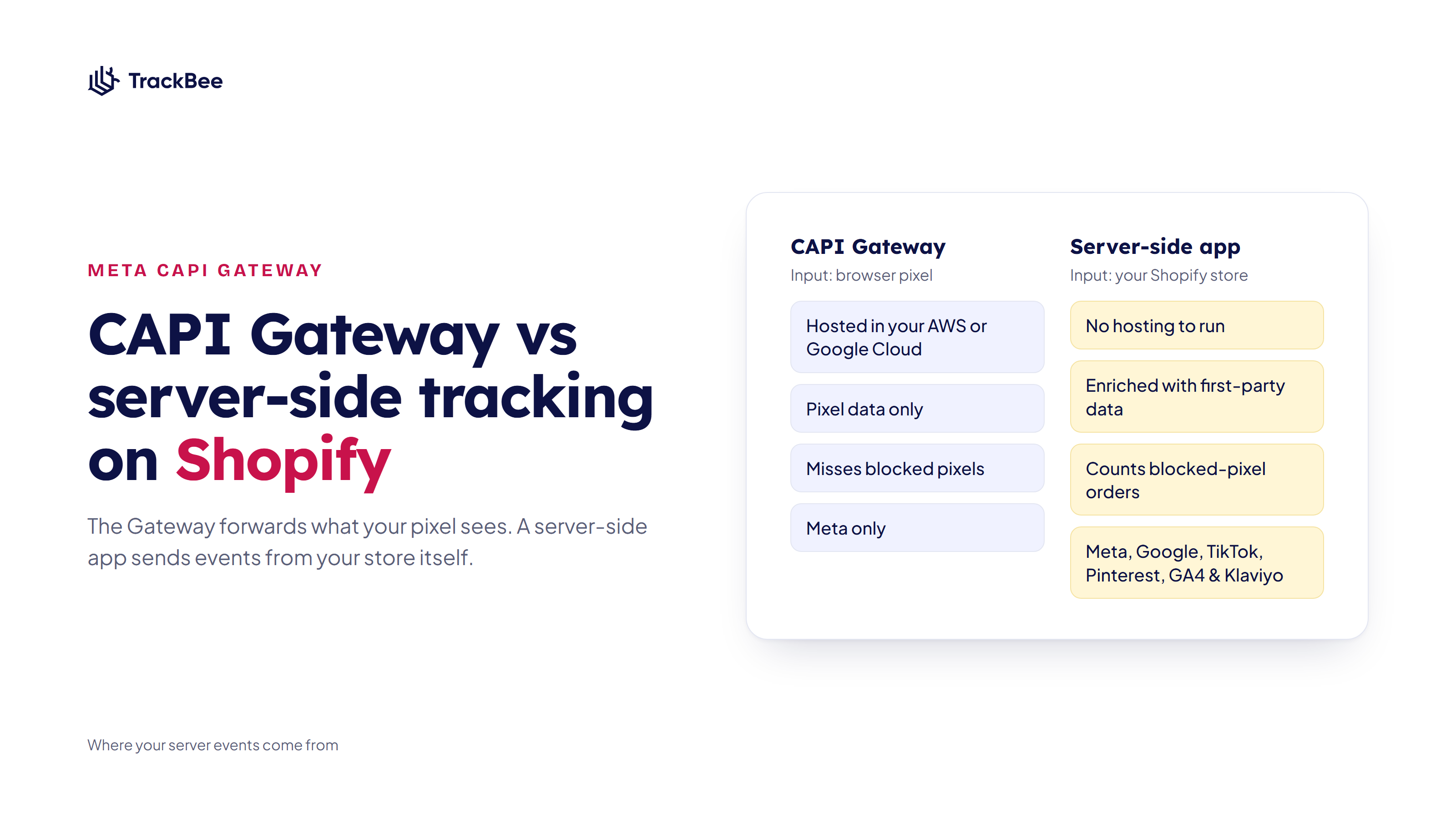
Meta CAPI Gateway forwards browser pixel events; a server-side tracking app sends events from the Shopify store itself
Frank de Vos
Frank de Vos
9
min read
CPM formula: ad cost divided by impressions times 1,000
Frank de Vos
Frank de Vos
10
min read